A unanimous Second Department Appellate Division panel overturned the conviction of Manhattan attorney Jeffery Kozlow, who was convicted of sending lewd e-mails and instant messages via the internet to a reader he thought was a juvenile but was, of course, a police officer.
The panel held in People v. Kozlow (linked here) that the law (Penal Law Section 235.22) required the sending of "visual" sexual images of sexual conduct. Descriptions of sex are not enough to trigger the statute. The actual statute reads:
" § 235.22 Disseminating indecent material to minors in the first degree.
A person is guilty of disseminating indecent material to minors in the
first degree when:
1. knowing the character and content of the communication which, in
whole or in part, depicts actual or simulated nudity, sexual conduct or
sado-masochistic abuse, and which is harmful to minors, he intentionally
uses any computer communication system allowing the input, output,
examination or transfer, of computer data or computer programs from one
computer to another, to initiate or engage in such communication with a
person who is a minor; and
2. by means of such communication he importunes, invites or induces a
minor to engage in sexual intercourse, oral sexual conduct or anal
sexual conduct, or sexual contact with him, or to engage in a sexual
performance, obscene sexual performance, or sexual conduct for his
benefit.
Disseminating indecent material to minors in the first degree is a
class D felony."
District attorney's around New York are "outraged", as are parents who do not properly control or supervise their children's internet use, along with everyone else who doesn't understand the importance of the First Amendment and the plain meaning of Congress shall inact no laws abridging the freedom of speech.
The rest of us (mostly defense and civil rights attorney's) are pleased to know that words alone are not enough.
I only wish the Appellate division had taken the time to write on the importance of the decision in light of the first amendment. Maybe explaining the ruling would have shut down a few District Attorney Public Relation hacks.
Saturday, July 29, 2006


Saturday, July 08, 2006
What Not To Say When Taking A Plea OR The Need To Prep Your Client For His Plea Allocution
Jeffrey Blunt, 23 years old, was taking a package plea that was going to net him a total of 9 years in jail. While he was admitting to the crime, the court asked him the standard question of whether he had taken any narcotic that may negate his ability to understand the plea. He admitted he had...Marijuana...While he was incarcerated at the Monroe County Jail!! He had already plead guilty to one of the crimes. The judge gave Jeffrey 15 years on that charge and must have threatened to give him the whole 19 years he faced because the Manslaughter 2* case starts on Monday.
There is a lesson here aside from the fact that Jeffrey "found God" a little earlier than he should have... Plea allocutions are often overlooked by busy defense counsel. The results could be, as in this case, devastating. Plea deals get lost, days in court are wasted, and counsel looks like an ass. (So does the client of course but in a case like Blunt's we didn't expect much more.) Potentially the client could lose a plea bargain exposing him to a lot more time as in the case above. He could also blow his chance at getting a substantial assistance departure, or could, under the right circumstance, earn himself a perjury charge. He could talk his way into a confession on a new charge (in the Blunt case above, promoting prison contraband.)
Blowing a plea allocution is not something that is a rarity either. As a Legal Aid lawyer back in the 80's, (can it be that long ago???) I used to see it happen a few times a week. The reason? Not taking the time to review the questions that the client will be asked.
Under Boykin v. Alabama, 395 U.S. 238 (1969), the Supreme Court set a standard for all plea allocutions. The NY Court of Appeals weighed in with its decision in People v. Harris, 61 NY2d 9 (1983). The standard requires that the defendant at the time of allocution make a "knowing, voluntary and intelligent waiver of their constitutional rights" (to a jury trial; to remain silent; to not have to present a defense but to put the prosecution to their burden; to a lawyer even if they cannot afford one.)
The Harris court stated that "a uniform mandatory catechism of pleading defendants is not required, and a sound discretion exercised on an individual basis is preferable to a ritualistic uniform procedure. A record that is silent will not overcome the presumption against waiver by a defendant of constitutionally guaranteed protections, but the record must show an intentional relinquishment or abandonment of a known right or privilege. A detailed articulation and waiver of the rights to a jury trial, the privilege against compulsory self incrimination and the right to confront accusers is not constitutionally mandated, although the Trial Judge must make sure that the accused has full understanding of what the plea connotes and of its consequences."
The record must be clear enough so that there is some evidence on the record which affirmatively discloses that the defendant understood the alternative to pleading guilty. (See Hanson v. Phillips, 442 F.3d 789 (2d Cir., 2006.)
Understanding that there is no hard and fast "script" that a judge must use, most ask at least the questions that a defense attorney in a civil deposition might ask a witness to satisfy the "knowing, voluntary and intelligent waiver part of the allocution. Hence, after asking about whether a defendant has been advised of their rights to: silence, to an attorney, and to a trial of their peers, the court will inquire if they understand they are entitled to those rights; if anyone has forced them to relinquish those rights; if any promises have been made to obtain the waiver (a smart defense counsel will pipe up, if the court doesn't, that there was an agreement to plead guilty to "X" crime for "Y" sentence wherein the court will ask "other than the plea agreement entered into, was there any other promises made by anyone to convince the defendant to take the plea); is the defendant acting voluntarily (that no one coerced him to take the plea); and it will often ask if he is in good health or has taken any drug or alcohol that would impair his ability to understand the proceedings.
Counsel for the defendant should review these concepts and ask the actual questions of the defendant even on the day of the plea. Make sure the defendant is ready to give the answers you want him to give. IF he fails to give those answers then you must determine why. You cannot advise him to lie to the court. You can however ask for a continuance, (which is what the attorney for Blunt above should have done had she known he had used cannibis that morning) or explain to the defendant his rights, what his answer will do to the proceeding, and if he still wants to plead guilty.
If necessary an Alford, (North Carolina v. Alford, 400 U.S. 25 [91 S.Ct. 160, 27 L.Ed.2d 162 or Serrano(state court) (People v. Serrano, 15 N.Y.2d 305 [196])plea should be entered into for the purpose of getting the deal done.
Taking the time to prep the defendant for the plea won't always result in a successful outcome. A defendant entering a plea who, either doesn't think he is guilty, or doesn't like the plea bargain, may still destroy the allocution, but at least you will know that you did what you could to save him from himself.
There is a lesson here aside from the fact that Jeffrey "found God" a little earlier than he should have... Plea allocutions are often overlooked by busy defense counsel. The results could be, as in this case, devastating. Plea deals get lost, days in court are wasted, and counsel looks like an ass. (So does the client of course but in a case like Blunt's we didn't expect much more.) Potentially the client could lose a plea bargain exposing him to a lot more time as in the case above. He could also blow his chance at getting a substantial assistance departure, or could, under the right circumstance, earn himself a perjury charge. He could talk his way into a confession on a new charge (in the Blunt case above, promoting prison contraband.)
Blowing a plea allocution is not something that is a rarity either. As a Legal Aid lawyer back in the 80's, (can it be that long ago???) I used to see it happen a few times a week. The reason? Not taking the time to review the questions that the client will be asked.
Under Boykin v. Alabama, 395 U.S. 238 (1969), the Supreme Court set a standard for all plea allocutions. The NY Court of Appeals weighed in with its decision in People v. Harris, 61 NY2d 9 (1983). The standard requires that the defendant at the time of allocution make a "knowing, voluntary and intelligent waiver of their constitutional rights" (to a jury trial; to remain silent; to not have to present a defense but to put the prosecution to their burden; to a lawyer even if they cannot afford one.)
The Harris court stated that "a uniform mandatory catechism of pleading defendants is not required, and a sound discretion exercised on an individual basis is preferable to a ritualistic uniform procedure. A record that is silent will not overcome the presumption against waiver by a defendant of constitutionally guaranteed protections, but the record must show an intentional relinquishment or abandonment of a known right or privilege. A detailed articulation and waiver of the rights to a jury trial, the privilege against compulsory self incrimination and the right to confront accusers is not constitutionally mandated, although the Trial Judge must make sure that the accused has full understanding of what the plea connotes and of its consequences."
The record must be clear enough so that there is some evidence on the record which affirmatively discloses that the defendant understood the alternative to pleading guilty. (See Hanson v. Phillips, 442 F.3d 789 (2d Cir., 2006.)
Understanding that there is no hard and fast "script" that a judge must use, most ask at least the questions that a defense attorney in a civil deposition might ask a witness to satisfy the "knowing, voluntary and intelligent waiver part of the allocution. Hence, after asking about whether a defendant has been advised of their rights to: silence, to an attorney, and to a trial of their peers, the court will inquire if they understand they are entitled to those rights; if anyone has forced them to relinquish those rights; if any promises have been made to obtain the waiver (a smart defense counsel will pipe up, if the court doesn't, that there was an agreement to plead guilty to "X" crime for "Y" sentence wherein the court will ask "other than the plea agreement entered into, was there any other promises made by anyone to convince the defendant to take the plea); is the defendant acting voluntarily (that no one coerced him to take the plea); and it will often ask if he is in good health or has taken any drug or alcohol that would impair his ability to understand the proceedings.
Counsel for the defendant should review these concepts and ask the actual questions of the defendant even on the day of the plea. Make sure the defendant is ready to give the answers you want him to give. IF he fails to give those answers then you must determine why. You cannot advise him to lie to the court. You can however ask for a continuance, (which is what the attorney for Blunt above should have done had she known he had used cannibis that morning) or explain to the defendant his rights, what his answer will do to the proceeding, and if he still wants to plead guilty.
If necessary an Alford, (North Carolina v. Alford, 400 U.S. 25 [91 S.Ct. 160, 27 L.Ed.2d 162 or Serrano(state court) (People v. Serrano, 15 N.Y.2d 305 [196])plea should be entered into for the purpose of getting the deal done.
Taking the time to prep the defendant for the plea won't always result in a successful outcome. A defendant entering a plea who, either doesn't think he is guilty, or doesn't like the plea bargain, may still destroy the allocution, but at least you will know that you did what you could to save him from himself.
Friday, July 07, 2006
Judge Treats Repeat DWI Offenders "Like Human Beings" and Gets Great Results: Now There's A Concept!
Memo to Nassau County District Attorney Kathleen Rice and Suffolk County District Attorney Tom Spota:
From our friends over at the CrimProf Blog, There is a judge who understands the concept of "Carrot and Stick" in Minnesota. The judge will take repeat offenders and spread their jail sentences out over years. He jails them for a month at a time in July and December. If they can prove to him that they have maintained employment, therapy, and sobriety, they miss that months jail until the next time when they have to do it all over again. Records show recidivism has been cut in half!!
Think about this. It encourages good behavior, it does away with the need for a probation violation hearing, it saves money on incarceration costs (because often the first time a repeat offender sees jail is on the felony conviction)and it reduces the need for costly trials which depend on a faulty machine working on voodoo science which often wind up with the prosecution losing.
Hmmm. Saves money, effectively reduces recidivism and isn't punitive. Come on guys. Do you have the guts to actually do something about the DWI problem? Or is it all a show for your MADD supporters?
Money quote Judge James Dehn said "It's about treating them (repeat drunk driving offenders) like human beings," Whoa, what a concept!
From our friends over at the CrimProf Blog, There is a judge who understands the concept of "Carrot and Stick" in Minnesota. The judge will take repeat offenders and spread their jail sentences out over years. He jails them for a month at a time in July and December. If they can prove to him that they have maintained employment, therapy, and sobriety, they miss that months jail until the next time when they have to do it all over again. Records show recidivism has been cut in half!!
Think about this. It encourages good behavior, it does away with the need for a probation violation hearing, it saves money on incarceration costs (because often the first time a repeat offender sees jail is on the felony conviction)and it reduces the need for costly trials which depend on a faulty machine working on voodoo science which often wind up with the prosecution losing.
Hmmm. Saves money, effectively reduces recidivism and isn't punitive. Come on guys. Do you have the guts to actually do something about the DWI problem? Or is it all a show for your MADD supporters?
Money quote Judge James Dehn said "It's about treating them (repeat drunk driving offenders) like human beings," Whoa, what a concept!
Tuesday, June 20, 2006
Some Interesting Things From The Week That Was
Well, as expected, there was barely time to read the paper and the blogs much less write for you all. I had a great time at Colonial Inauguration while at The George Washington University. I have to admit Orientation has come a long way since I went to college (for example Freshman no longer have to wear beanies.) Any way GW put on quite the show. A lot of information, comradery, and entertainment. I especially enjoyed President Steven Joel Tractenburg's welcome to the class of 2010. I think my son will be very happy here.
As for the "News" this week, I guess the lead off story would have to be the SCOTUS decision in Hudson v. Michigan. Contrarian that I am, I will end this post with some thoughts on that. First a few words of advice to lawyers about a couple of Ethics cases.
I. Beech v. Lefcourt: Can an Attorney be forced to return a collected fee for failure to obtain a retainer agreement or send a letter confirming same?
First there was the civil court decision (found here)in Beech v. Lefcourt which, while not binding is a very sound decision and one that I hope will be followed. It deals with how we should handle the failure of an attorney to have a retainer letter in a case.
Mr. Beech retained the well-known and highly regarded Gerald Lefcourt to represent him in Nassau County on a Drug charge. The Fee paid was Fifteen Thousand Dollars. There was some question as to whether the fee was for representation or remaining available to consult on the case presumably with local counsel.
Beech sought return of the funds because Lefcourt did not give him a written retainer as is required by 22NYCRR Sec.1215.1c. The court held that while the defendant (in this case Mr. Lefcourt) could not sue to obtain his fee, he did not have to return any of the fee already collected. This case appears to be a case of first impression. There are a number of cases that have held that sans a retainer letter or agreement a lawyer cannot collect his fee or any unpaid portion thereof, there was no decision as to whether 1215.1c required forfeiture for sums already submitted. This is not to say that the plaintiff could not try to recover the sums as part of a quantum meruit recovery but 1215.1c will not act as an opportunity for a windfall for the plaintiff.
A fair moral for this story is...get a retainer letter signed by the client or at the very least send a letter of engagement so you're covered. That is not to say that sometimes things fall through the cracks. Which leads us to case two:
II. In the Matter of Aranda: Failure to tell client attorney has "blown" his Statute of Limitations causes 1 year suspension.
Lessen two for lawyers comes at the expense of a small firm practioner who was spread too thin. The attorney in Matter of Aranda (First Dept decision here)has made a career of taking on the hardest litigation, on behalf of a truly legally underserved community in Washington Heights in upper NYC.
Aranda evidentially had let too many things fall through the cracks and had neglected a client's case for false arrest letting the statute of limitations run. He also failed to tell the client that the statute had run. While handling this matter, Aranda was also securing the release of one of NY's innocent convicted, Olmedo Hildago (case synopsis here.)
At his hearing, Aranda took responsibility for some of the problems in the office but also complained of some problems with help and staff. The referee recommended a year suspension. The Grievance counsel wanted an 18 month suspension. A hearing was held before the grievance committee and the committee recommended a 5 month suspension as this was not a first offense. The court upheld the committee's dismissal of two counts of the complaint and then sentenced to 1 year's suspension anyway. What I found most disturbing is that they reached back almost 17 years to some really early discipline to make their case for the longer suspension. There was little proof that the Appellate Division First Department looked at the accused attorney's record or considered the substantial amount of support the individual had from jurists, clients, fellow lawyers or even a legislator. If I were on the committee that had ordered five months suspension I would be pretty ticked off too.
I think the better way to handle the discipline of attorneys would be to have the courts appoint the committee, have the committee hold the hearing and only disturb the hearing committee's decision if it were an abuse of discretion. It has got to be difficult for judges of the Appellate Division to remember the hard times of practicing law. They have usually been judges for so long it isn't easy to put oneself back in that venue (assuming they ever did practice law in a firm or private bar setting.) Moreover, even if they can remember and empathize, the economics and culture of the private law practice has changed so dramatically that they are out of touch with it. A practioner's panel is better suited to determine the punishment necessary to correct the behavior. I also think that the question of whether the lawyer carried malpractice insurance should be part of the equation. If the client can still be made whole then that should dampen any punishment.
I doubt the court would ever voluntarily give up the power to punish the behaviors of attorneys but the rule ought to be changed. Maybe there is a legislator who would put a bill in that may get the court's attention. Maybe it will be the Assemblyman who testified and who was ignored by the court's decision.
III. App. Div. Chiefs call for comment on new rules concerning Internet and personal injury advertising.
The Presiding Judges of the Four Appellate Divisions have promulgated a slew of new disciplinary rules to govern attorney advertising and solicitation. You can find the new rules here. Most of the rules mirror those proposed by the State Bar Task Force on Lawyer Advertising and Solicitation aka the Lieber committee.
The proposals are far reaching, and concern everything from the length of time attorneys must keep their advertising to coverage of attorney's from outside the state who solicit clients within the state. It forbids the use of certain trade names and advertising ploys such as paid testimonials and endorsements.
I have given these rules a tertiary review and find them objectionable in a number of ways.
1. I think the waiting period for soliciting a client in a tort is way to long. In 30 days (the amount of time the attorney must wait to solicit a tort client)the insurance company can inflict major harm to the client's case. Without quick contact by a lawyer, a client may sign a statement that is not phrased in his interest or may be inclined to sign a waiver of claim or even a settlement. Many tort clients are poor and uneducated. They are far more open to being coerced or unfairly pushed by unscrupulous insurance adjusters to settle a case before an attorney can get to them or they to an attorney. A five or seven day wait is far more reasonable and will stop the client from being overwhelmed in most cases.
2 a Three year waiting and holding period is again to long a period to have to hold on to your ads. Especially since our websites change daily with news feeds or newsletters. The rules seem unclear if I have to print out the links to my news feed or if I just need to print the feeds themselves. Nevertheless this will still force me to hold onto 800 pages of paper a year. What about a lawyer's blog? Do I have to copy and keep every page of it. Not only is that a waste but it is shows the court is not acquainted with the concept of cache copies.
3. The court wants us to hold onto the lists of all of those who are solicited along with a copy of the individual solicitation. This seems to be an attempt to control spamming clients. It is not on its own a bad idea. However what about if the list of those solicited includes people involved in a bad act or in other risqué business that they ultimately are never prosecuted for? How are we to be assured their "business dealings" or names will not be revealed to authorities?
What effect would an e-mail from a criminal lawyer do to them if the authorities found out they were being made aware of the lawyer's availability.
I may have more on this after I have had a chance to digest the document further.
IV. Hudson v. Michigan:Wither the Knock and Announce Rule?"
There is a lot of hand wringing and fear being bandied about on this decision which holds that exclusion of evidence is too harsh a remedy in a situation where the police have a warrant to search a place but fail to wait the right amount of time before forcibly breaking into a person's home. AP handles the decision
here.
Professor Orin Kerr has a number of posts here,here, and here. An even more thorough analysis is found at SCOTUSBLOG here The discussion in the comments also are very though provoking. BTW you can link to the actual decisions here.
I think this decision is a tempest in a teapot right now. Sure it can be seen as if it portends more chipping away at the exclusionary rule but for the reasons Prof. Kerr points out it is not out of whack with the courts recent rulings on suppression issues and it does preserve the right to suppression in other Fourth Amendment settings. I also think Scalia and Kennedy's decisions will go a far way in getting better instructions in 1983 actions.
That's all for now.
As for the "News" this week, I guess the lead off story would have to be the SCOTUS decision in Hudson v. Michigan. Contrarian that I am, I will end this post with some thoughts on that. First a few words of advice to lawyers about a couple of Ethics cases.
I. Beech v. Lefcourt: Can an Attorney be forced to return a collected fee for failure to obtain a retainer agreement or send a letter confirming same?
First there was the civil court decision (found here)in Beech v. Lefcourt which, while not binding is a very sound decision and one that I hope will be followed. It deals with how we should handle the failure of an attorney to have a retainer letter in a case.
Mr. Beech retained the well-known and highly regarded Gerald Lefcourt to represent him in Nassau County on a Drug charge. The Fee paid was Fifteen Thousand Dollars. There was some question as to whether the fee was for representation or remaining available to consult on the case presumably with local counsel.
Beech sought return of the funds because Lefcourt did not give him a written retainer as is required by 22NYCRR Sec.1215.1c. The court held that while the defendant (in this case Mr. Lefcourt) could not sue to obtain his fee, he did not have to return any of the fee already collected. This case appears to be a case of first impression. There are a number of cases that have held that sans a retainer letter or agreement a lawyer cannot collect his fee or any unpaid portion thereof, there was no decision as to whether 1215.1c required forfeiture for sums already submitted. This is not to say that the plaintiff could not try to recover the sums as part of a quantum meruit recovery but 1215.1c will not act as an opportunity for a windfall for the plaintiff.
A fair moral for this story is...get a retainer letter signed by the client or at the very least send a letter of engagement so you're covered. That is not to say that sometimes things fall through the cracks. Which leads us to case two:
II. In the Matter of Aranda: Failure to tell client attorney has "blown" his Statute of Limitations causes 1 year suspension.
Lessen two for lawyers comes at the expense of a small firm practioner who was spread too thin. The attorney in Matter of Aranda (First Dept decision here)has made a career of taking on the hardest litigation, on behalf of a truly legally underserved community in Washington Heights in upper NYC.
Aranda evidentially had let too many things fall through the cracks and had neglected a client's case for false arrest letting the statute of limitations run. He also failed to tell the client that the statute had run. While handling this matter, Aranda was also securing the release of one of NY's innocent convicted, Olmedo Hildago (case synopsis here.)
At his hearing, Aranda took responsibility for some of the problems in the office but also complained of some problems with help and staff. The referee recommended a year suspension. The Grievance counsel wanted an 18 month suspension. A hearing was held before the grievance committee and the committee recommended a 5 month suspension as this was not a first offense. The court upheld the committee's dismissal of two counts of the complaint and then sentenced to 1 year's suspension anyway. What I found most disturbing is that they reached back almost 17 years to some really early discipline to make their case for the longer suspension. There was little proof that the Appellate Division First Department looked at the accused attorney's record or considered the substantial amount of support the individual had from jurists, clients, fellow lawyers or even a legislator. If I were on the committee that had ordered five months suspension I would be pretty ticked off too.
I think the better way to handle the discipline of attorneys would be to have the courts appoint the committee, have the committee hold the hearing and only disturb the hearing committee's decision if it were an abuse of discretion. It has got to be difficult for judges of the Appellate Division to remember the hard times of practicing law. They have usually been judges for so long it isn't easy to put oneself back in that venue (assuming they ever did practice law in a firm or private bar setting.) Moreover, even if they can remember and empathize, the economics and culture of the private law practice has changed so dramatically that they are out of touch with it. A practioner's panel is better suited to determine the punishment necessary to correct the behavior. I also think that the question of whether the lawyer carried malpractice insurance should be part of the equation. If the client can still be made whole then that should dampen any punishment.
I doubt the court would ever voluntarily give up the power to punish the behaviors of attorneys but the rule ought to be changed. Maybe there is a legislator who would put a bill in that may get the court's attention. Maybe it will be the Assemblyman who testified and who was ignored by the court's decision.
III. App. Div. Chiefs call for comment on new rules concerning Internet and personal injury advertising.
The Presiding Judges of the Four Appellate Divisions have promulgated a slew of new disciplinary rules to govern attorney advertising and solicitation. You can find the new rules here. Most of the rules mirror those proposed by the State Bar Task Force on Lawyer Advertising and Solicitation aka the Lieber committee.
The proposals are far reaching, and concern everything from the length of time attorneys must keep their advertising to coverage of attorney's from outside the state who solicit clients within the state. It forbids the use of certain trade names and advertising ploys such as paid testimonials and endorsements.
I have given these rules a tertiary review and find them objectionable in a number of ways.
1. I think the waiting period for soliciting a client in a tort is way to long. In 30 days (the amount of time the attorney must wait to solicit a tort client)the insurance company can inflict major harm to the client's case. Without quick contact by a lawyer, a client may sign a statement that is not phrased in his interest or may be inclined to sign a waiver of claim or even a settlement. Many tort clients are poor and uneducated. They are far more open to being coerced or unfairly pushed by unscrupulous insurance adjusters to settle a case before an attorney can get to them or they to an attorney. A five or seven day wait is far more reasonable and will stop the client from being overwhelmed in most cases.
2 a Three year waiting and holding period is again to long a period to have to hold on to your ads. Especially since our websites change daily with news feeds or newsletters. The rules seem unclear if I have to print out the links to my news feed or if I just need to print the feeds themselves. Nevertheless this will still force me to hold onto 800 pages of paper a year. What about a lawyer's blog? Do I have to copy and keep every page of it. Not only is that a waste but it is shows the court is not acquainted with the concept of cache copies.
3. The court wants us to hold onto the lists of all of those who are solicited along with a copy of the individual solicitation. This seems to be an attempt to control spamming clients. It is not on its own a bad idea. However what about if the list of those solicited includes people involved in a bad act or in other risqué business that they ultimately are never prosecuted for? How are we to be assured their "business dealings" or names will not be revealed to authorities?
What effect would an e-mail from a criminal lawyer do to them if the authorities found out they were being made aware of the lawyer's availability.
I may have more on this after I have had a chance to digest the document further.
IV. Hudson v. Michigan:Wither the Knock and Announce Rule?"
There is a lot of hand wringing and fear being bandied about on this decision which holds that exclusion of evidence is too harsh a remedy in a situation where the police have a warrant to search a place but fail to wait the right amount of time before forcibly breaking into a person's home. AP handles the decision
here.
Professor Orin Kerr has a number of posts here,here, and here. An even more thorough analysis is found at SCOTUSBLOG here The discussion in the comments also are very though provoking. BTW you can link to the actual decisions here.
I think this decision is a tempest in a teapot right now. Sure it can be seen as if it portends more chipping away at the exclusionary rule but for the reasons Prof. Kerr points out it is not out of whack with the courts recent rulings on suppression issues and it does preserve the right to suppression in other Fourth Amendment settings. I also think Scalia and Kennedy's decisions will go a far way in getting better instructions in 1983 actions.
That's all for now.
Monday, June 12, 2006
Civil Rights Issues Dominate This Weekend's News
I noticed a number of articles in Friday and Saturday's paper that focused our attention on the concepts I work on in the other half of my practice, Civil Rights litigation.
Though I trained as a criminal lawyer, I saw a real link between criminal cases and civil liberties issues. I always felt that those civil cases should also be a part of the criminal lawyers case load. Hence I started to add them to our work about 16 years ago. Now Civil rights cases make up about 30 percent of the total work we do in our office and about 60 percent of our civil caseload. (The other 40 percent is made up of Family and Matrimonial cases that are founded in Domestic violence, Civil Rico claims, Construction claims and Qui tam (aka whistleblower) cases.)
This weekend's new saw a number of Civil Rights stories.
For example there is a new attempt to legitimize racial profiling. State Senator Serf Maltese and Assemblyman Dov Hikind both are supporting a bill (S. 8057/A.11536), that would allow police to stop and question, as well as search, people based on their religious and ethnic backround.
According to Newsday (link here) "The proposed legislation would authorize law enforcement officials to "consider race and ethnicity as one of many factors that could be used in identifying persons who can be initially stopped, questioned, frisked and/or searched."
I guess I should be shocked that Hikind would support this type of measure. He of all people (being an Orthodox Jew and representing the Boro Park area of Brooklyn which counts many Hasidic and Orthodox Jews from Eastern Europe among his constituents) should fear any legislation that makes it legal for the government to hassle citizens based on their ethnic or religious heritage. Is Kristallnacht forgotten so soon?
I can understand how the legislation makes sense to people at first blush. After all most terrorists today seem to be Muslim and we are actively engaged in a war in two predominately Muslim countries. Most Muslims however are not terrorists. Allowing the police to just go up to someone and stop, frisk, or search them (much less arrest them) gives those citizens far fewer rights than the rest of us have, without them having done anything besides being birthed.
Racial profiling also doesn't work and it tends to make police departments lazy. The last thing we need now in these hours of vigilance is for the police to become lazy. Racial profiling tends to keep police from looking at people who do not fit the profile. That can be dangerous. While it is unlikely that a Ninety year old Presbyterian woman will be a shoe bomber, there is some efficacy to making everyone a little nervous about the chance that they may be investigated randomly.
Would Hikind and Maltese support a bill that allowed greater intrusions into the life of Blacks or Hispanics? If our nation is willing to start to segregate people for their ethnic and religious upbringing, isn't that giving the enemy what they want? In a sense guys like Senator Maltese and Assemblyman Hikind are really traitors to the American way of life.
This is unsound legislation that is probably causing Benjamin Franklin to turn in his grave. He said it best. I keep repeating it. " A nation that sacrifices freedom for security, gets not the latter and deserves not the former."
Now for a politician who seems to understand Ole Ben just fine, we have New York City Mayor Michael Bloomberg giving the commencement speech at the University of Chicago. Now I am a bit of a fan of the mayor's even though I would disagree with him on a number of things his police department has been up to, However in this article the Mayor does us proud. Without singling out any specific person, Bloomberg sticks it to the far right neo-con wing of the Republican party. Here is the money quote:
""We all have to get together in this country and stop this right now and stand up to those who would demagogue." "There is nothing _ absolutely nothing _ wrong with criticizing our government, on any topic, and challenging it to live up to the democratic ideals. It is not unpatriotic. In fact, what could be more patriotic?"
Right On Mr. Mayor!!!
On the other hand, what good is protesting or criticizing the government if no one can hear you? In this article, a Queens man, Geoffrey Blank, is facing a felony for using a megaphone (a ten watter) to lead anti-war peace rallies in Mayor Bloomberg's own NYC (Union Square to be exact.) He is alleged to be starting a riot and using his amp without a proper permit. He claims he has asked over and over for the permit and is continually turned down. Police say it is because he doesn't follow procedures. You see, to use a megaphone in a park, you first have to get permission of the Parks Department THEN you ask the police. He has been arrested several times. His first case is coming to trial next week.
It's a big city with a lot of people in it. There do have to be rules so that when Mr. Blank is protesting the war, I can still listen to Coltrane on my ipod or walk my dog or play with my kids. I think however there is a way to coordinate political rallies without having to go through at least two different agencies to get the proper permit. This isn't the same as putting on a concert in a park or even organizing a run. In political speech, time is of the essence and there should be a streamlined way of getting the paperwork accomplished. Moreover, I am not sure how much noise a 10 watt megaphone makes, but I would have to be pretty sure it was really annoying before I would use a rule like that to put First Amendment rights asunder.
Now while I have been rattling on about these happenings I should also mention that there was another case where First Amendment issues and criminal law were implicated. That was in the conviction of Nick Minucci a kid in Howard Beach that beat up a black guy who was looking for a car to steal in that neighborhood.
Not only was Minucci convicted, he was found guilty of a racially motivated attack which carries with it enhanced penalties.
According to the press Minucci said "I'll teach you Ni--ers to rob white people" or words to that effect. I have a problem with race crimes based on words alone. I assume Minucci was guilty of assault because if he acted in self defense or defense of property, he would not be convicted. The question I have is would Minucci have acted differently had the potential crook been white or hispanic? Would he have just walked away? If there is not proof beyond a reasonable doubt that he would have acted differently, then isn't it true that we are enhancing his punishment because he holds opinions we as a citizenry frown on.
It is not unconstitutional to be racist or to say racist things. It is politically incorrect however. It seems to me that if the only reason this becomes a race crime is because of the N word said in the heat of an argument or fight, then that would be an example of the legislature making a law that restricts speech. It seems that enhancing penalties only because of something a person says, is in fact, unconstitutional. I really think these race motivated crime statutes need to be rethought by the legislature, and this one needs to get tossed out by our courts.
Though I trained as a criminal lawyer, I saw a real link between criminal cases and civil liberties issues. I always felt that those civil cases should also be a part of the criminal lawyers case load. Hence I started to add them to our work about 16 years ago. Now Civil rights cases make up about 30 percent of the total work we do in our office and about 60 percent of our civil caseload. (The other 40 percent is made up of Family and Matrimonial cases that are founded in Domestic violence, Civil Rico claims, Construction claims and Qui tam (aka whistleblower) cases.)
This weekend's new saw a number of Civil Rights stories.
For example there is a new attempt to legitimize racial profiling. State Senator Serf Maltese and Assemblyman Dov Hikind both are supporting a bill (S. 8057/A.11536), that would allow police to stop and question, as well as search, people based on their religious and ethnic backround.
According to Newsday (link here) "The proposed legislation would authorize law enforcement officials to "consider race and ethnicity as one of many factors that could be used in identifying persons who can be initially stopped, questioned, frisked and/or searched."
I guess I should be shocked that Hikind would support this type of measure. He of all people (being an Orthodox Jew and representing the Boro Park area of Brooklyn which counts many Hasidic and Orthodox Jews from Eastern Europe among his constituents) should fear any legislation that makes it legal for the government to hassle citizens based on their ethnic or religious heritage. Is Kristallnacht forgotten so soon?
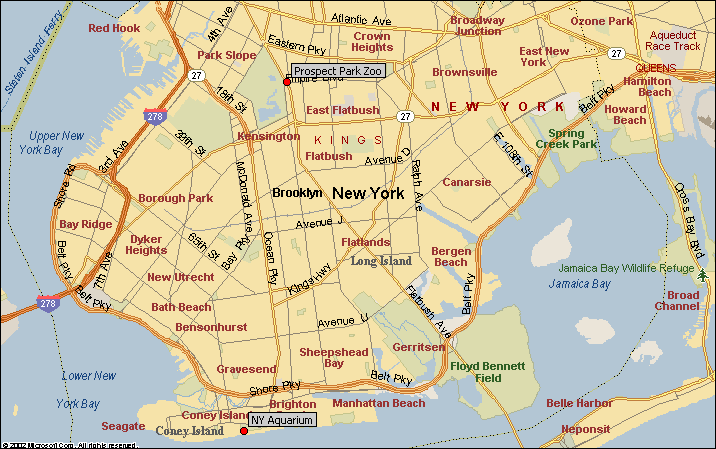
I can understand how the legislation makes sense to people at first blush. After all most terrorists today seem to be Muslim and we are actively engaged in a war in two predominately Muslim countries. Most Muslims however are not terrorists. Allowing the police to just go up to someone and stop, frisk, or search them (much less arrest them) gives those citizens far fewer rights than the rest of us have, without them having done anything besides being birthed.
Racial profiling also doesn't work and it tends to make police departments lazy. The last thing we need now in these hours of vigilance is for the police to become lazy. Racial profiling tends to keep police from looking at people who do not fit the profile. That can be dangerous. While it is unlikely that a Ninety year old Presbyterian woman will be a shoe bomber, there is some efficacy to making everyone a little nervous about the chance that they may be investigated randomly.
Would Hikind and Maltese support a bill that allowed greater intrusions into the life of Blacks or Hispanics? If our nation is willing to start to segregate people for their ethnic and religious upbringing, isn't that giving the enemy what they want? In a sense guys like Senator Maltese and Assemblyman Hikind are really traitors to the American way of life.
This is unsound legislation that is probably causing Benjamin Franklin to turn in his grave. He said it best. I keep repeating it. " A nation that sacrifices freedom for security, gets not the latter and deserves not the former."
Now for a politician who seems to understand Ole Ben just fine, we have New York City Mayor Michael Bloomberg giving the commencement speech at the University of Chicago. Now I am a bit of a fan of the mayor's even though I would disagree with him on a number of things his police department has been up to, However in this article the Mayor does us proud. Without singling out any specific person, Bloomberg sticks it to the far right neo-con wing of the Republican party. Here is the money quote:
""We all have to get together in this country and stop this right now and stand up to those who would demagogue." "There is nothing _ absolutely nothing _ wrong with criticizing our government, on any topic, and challenging it to live up to the democratic ideals. It is not unpatriotic. In fact, what could be more patriotic?"
Right On Mr. Mayor!!!
On the other hand, what good is protesting or criticizing the government if no one can hear you? In this article, a Queens man, Geoffrey Blank, is facing a felony for using a megaphone (a ten watter) to lead anti-war peace rallies in Mayor Bloomberg's own NYC (Union Square to be exact.) He is alleged to be starting a riot and using his amp without a proper permit. He claims he has asked over and over for the permit and is continually turned down. Police say it is because he doesn't follow procedures. You see, to use a megaphone in a park, you first have to get permission of the Parks Department THEN you ask the police. He has been arrested several times. His first case is coming to trial next week.
It's a big city with a lot of people in it. There do have to be rules so that when Mr. Blank is protesting the war, I can still listen to Coltrane on my ipod or walk my dog or play with my kids. I think however there is a way to coordinate political rallies without having to go through at least two different agencies to get the proper permit. This isn't the same as putting on a concert in a park or even organizing a run. In political speech, time is of the essence and there should be a streamlined way of getting the paperwork accomplished. Moreover, I am not sure how much noise a 10 watt megaphone makes, but I would have to be pretty sure it was really annoying before I would use a rule like that to put First Amendment rights asunder.
Now while I have been rattling on about these happenings I should also mention that there was another case where First Amendment issues and criminal law were implicated. That was in the conviction of Nick Minucci a kid in Howard Beach that beat up a black guy who was looking for a car to steal in that neighborhood.
Not only was Minucci convicted, he was found guilty of a racially motivated attack which carries with it enhanced penalties.
According to the press Minucci said "I'll teach you Ni--ers to rob white people" or words to that effect. I have a problem with race crimes based on words alone. I assume Minucci was guilty of assault because if he acted in self defense or defense of property, he would not be convicted. The question I have is would Minucci have acted differently had the potential crook been white or hispanic? Would he have just walked away? If there is not proof beyond a reasonable doubt that he would have acted differently, then isn't it true that we are enhancing his punishment because he holds opinions we as a citizenry frown on.
It is not unconstitutional to be racist or to say racist things. It is politically incorrect however. It seems to me that if the only reason this becomes a race crime is because of the N word said in the heat of an argument or fight, then that would be an example of the legislature making a law that restricts speech. It seems that enhancing penalties only because of something a person says, is in fact, unconstitutional. I really think these race motivated crime statutes need to be rethought by the legislature, and this one needs to get tossed out by our courts.
Head of Homicide Fred Klein & Nassau District Attorney Rice Part Ways
This came as no suprise to me, having been watching the goings on over on the second floor at 262 Old Country Road, Mineola. I was just suprised it didn't happen sooner.
Nevertheless, as much as it may suprise some, I am not going to use this post to criticize Rice for the decision.
Rice is newly elected and she has a right to her own people. Klein served her predessor (and our county) well. He is a brilliant and hard working attorney. I have often disagreed with him on cases but I always considered him a friend. As such I will miss him. On the other hand I hope that Rice intends to fill the shoes she has caused to go vacant with another outstanding lawyer and not another administrative crony.
What made Fred Klein so effective as a leader and as the Head of Nassau County's Major Offense Bureau was that he tried cases. He could evaluate the matter and when plea bargaining the case with him, you knew he had a good handle on its viability at trial. Hence even when you thought you had a good case, you had to think twice about it if Fred wasn't willing to get rid of it with a fair plea bargain. Even after he took the job as Bureau chief, Fred kept trying cases. It was one of the things I admired about him. I don't know what Fred plans to do now that he is done at the District Attorney's office. I do know that he would make a great private lawyer, assuming he can make the switch from prosecutor to non public trial lawyer. If he decides to stay in public service it will be to the good of all of us.
The Newspaper said that Rice and Klein didn't see eye to eye. OK like I said she is entitled to her own people. As a taxpayer and citizen however, one who has paid for Fred Klein's training and has benefitted from his work, the newbie doesn't get a honeymoon. He or she better know what they are doing from the jump. This work is too important to learn on the job.
Nevertheless, as much as it may suprise some, I am not going to use this post to criticize Rice for the decision.
Rice is newly elected and she has a right to her own people. Klein served her predessor (and our county) well. He is a brilliant and hard working attorney. I have often disagreed with him on cases but I always considered him a friend. As such I will miss him. On the other hand I hope that Rice intends to fill the shoes she has caused to go vacant with another outstanding lawyer and not another administrative crony.
What made Fred Klein so effective as a leader and as the Head of Nassau County's Major Offense Bureau was that he tried cases. He could evaluate the matter and when plea bargaining the case with him, you knew he had a good handle on its viability at trial. Hence even when you thought you had a good case, you had to think twice about it if Fred wasn't willing to get rid of it with a fair plea bargain. Even after he took the job as Bureau chief, Fred kept trying cases. It was one of the things I admired about him. I don't know what Fred plans to do now that he is done at the District Attorney's office. I do know that he would make a great private lawyer, assuming he can make the switch from prosecutor to non public trial lawyer. If he decides to stay in public service it will be to the good of all of us.
The Newspaper said that Rice and Klein didn't see eye to eye. OK like I said she is entitled to her own people. As a taxpayer and citizen however, one who has paid for Fred Klein's training and has benefitted from his work, the newbie doesn't get a honeymoon. He or she better know what they are doing from the jump. This work is too important to learn on the job.
Sunday, June 04, 2006
Live From Miami Beach: Pleabargaining Post Booker UPDATED
I finally updated and corrected my final post from the 15th Annual National Federal Sentencinig Guidelines Seminar. This was the best of the 5 breakout sessions I attended. I strongly urge any and all Defense practioners to review some of the sections of the Guidelines especially those that have recently been added. I will be posting some final thoughts about Miami a little later today or this week.
Friday, June 02, 2006
Live from Miami IV: Plea Bargaining Post Booker
I found this to be an excellent and well prepared panel probably the best of the conference to this point.
This panel features ABA CJS Committee chair on Sentencing and Incarceration Barry Boss
Hon Judge Downes (replacing Judge Lee of the ND VA.)
Jeff Sloman Chief of Criminal in SD Fl.
Les Zorn- US Dept of Probation
Stats in the Courtroom:Beryl Howell USSC:
DoJ feared more trials govt would have less leverage to require snitches and less incentive to plea out early:
1 year later the stats show:
A crim trials up slightly to 5.5% from 4% of 70K+ cases
b. Govt sponsered departs and substantial assistance motions is flat 14% same as before
c. early plea is still up at 68% over 63 and 62 percent in 03 and 02
Barry Boss Defense attorney:
PB remains an uphill battle. There are 2 types of agreements 1 where we agree and 2 where we think it should be probation and they think it is life.
often however you and pros agree but the guidelines stand in the way.
In the second section is trying to get an opportunity to litigate our differences andso we may not want to sign the plea agreemt Post BOoker
Post Booker you may want to waive your appeal w/ the Prosecution.
18usc 1871 Rights to victims acr which allows a mandamus.
Zorn: PO needs to look to the plea agreement and digest it but then you still must do an independant inquiry. our main objective is to get information that we feel should go to the court. We prepare our reports for our judges not the Prosecutor or Defense lawyer or even the victim.
One element we deal with is 3553a factors do not appear in the plea agreement. Our job is to bring that information to the court as well. Def atty should Bring the issues to the PO Early on. We will make every effort to look into those issues.
Plea agreements are getting more detailed which include guideline calcs. We though have to check those and advise the application provisions to the court.
Sloman: DOJ Disagrees with what the stats show. AG GOnzolez says is still with the topless guideline. There is concern with the sexual abuse issues.
Judge Downs respectfully disagrees with AG Gonzolez on the sex crime issue. There is not
There is a power struggle going on tween the DOJ and the A3 judges. I respect his job but it alarms judges that before we let dust settle on Booker
There is a need to get a fix before we know we need a fix.
Article III jdges doing goofy things but the Ct of App will reach the right result and the Supremes will straighten out the conflicts
SOme members aree pandering in certain types of crimes. Esp Sex Crimes.
Relying on antedotal evidence to make
I don't kjnow of a signle man min sent is antithetical to sound sentencing policy. The experts are telling them that this will wreak real havoc and will undue the sentencing guidelines.
I don't have to accept 11c1c agreements.
Historical drug conspiracys are seeing these 11c1c dispos
Pleas whats contained Stips as to relevent conduct and stips to a specific sentence guideline may accept that the agreed sentence if it is within the guideline range or if outside the court is convinced the reasons for same is
If I am going to reject then I must give notice and then deft can withdraw the plea. IF not deft has to be put on notice that he may not get the dispo he decided.
There will be more binding 11c1c agreements. the court should not just reject them willy nilly but it should require the writer of the report to do this
moderator asks:
How do you insulate a stip from the court and PO?
Boss: On C1c pleas, both sides want to get stability and predicability. ON C1c pleas you must look at guideline 6B1.2, however while it applies to C1C pleas, it is antiquated and not adjusted for Booker. It is no longer accurate. So you can get the court to accept a departure or a C1c agreement now even if the departure would not be a justifiable departure in the guideline book/
Stip factors of 3553a material into the fact in the plea agreement to cover the factors in the agreement
with Regard to particular stips we can maximize the chance it sticks. Word it that the prosecution cannot prove the fact of an upward adjustment beyond a preponderance of the evidence. Unless the judge holds his own hearing your good.
Sloman: Deft. looking for a slant on a case can be dangerous. Now there may be a witness who can hurt your stip but getting on the record that the case can't be proved beyond a preponderance so that if the AUSA can't cooberate the fact then the opinon is not intellectually dishonest.
Moderator: DoJ has a long standing fear of 5k1 adj being given without a govt motion. Have you seen situations where the judge has granted a downward departure where the govt hasnt sponsered it because the cooperation provided didn 't rise to the level of substantial assistance. Booker will not affect the cooperation numbers because someone who wants to cooperate will go down the government's road. The 5k departure will only count with "imperfect cooperation"
Sloman's concern is not with the guy who tried his best and goes as far as he can go or the guy who is in a long term cooperation agrerement has done a lot of really good stuff and maybe has stuff he is working on but comes to sentencing and says let me tell you what he has done. With work out there to be done it is not a full picture of the defendant.
Of course where a guy is only facing 36 months and your in your 19 month with 2 trials to go then maybe you have no choice but to push it/
Note there are only 28 cases system wide where 3553a variances were given just on cooperation issues alone.
Crime Victiims Rights Act of 2004.
Requires victims a rt to be heard ussg 6A1.5 reflects the act
How is CVRA playing out in the courtroom and in plea barginging.
Barry Boss: you have to know the victim has significant rights you may want the AUSA and have them sign off on the agreement not to participate in the process.
Sloman:
Crime vic is not the prosecutors best friend. A Botox posioning case (fake botox) victim thinks the death penalty was too good for the deft. but the AusA did come to an agreement. The victim came in and railed against the pros and the deft! judge ignored them.
They can face disiplinary charges for willful and wanton disregaurd for the victims rights.
Zorn spoke to the PO as a victims voice in the probation report, We see there is another level of reporting. Probation thinks it adds to the information the court has and likes the new law.
Under the circumstances where you think the victim is going to not go with the plea, you should seek out a C1c plea. C1c is not only good as to the actual sentencing but to the sentencing factors. Maybe the thing to do if you can't agree on the actual sentence but you can get the facts in a stip to protect from the victim.
This panel features ABA CJS Committee chair on Sentencing and Incarceration Barry Boss
Hon Judge Downes (replacing Judge Lee of the ND VA.)
Jeff Sloman Chief of Criminal in SD Fl.
Les Zorn- US Dept of Probation
Stats in the Courtroom:Beryl Howell USSC:
DoJ feared more trials govt would have less leverage to require snitches and less incentive to plea out early:
1 year later the stats show:
A crim trials up slightly to 5.5% from 4% of 70K+ cases
b. Govt sponsered departs and substantial assistance motions is flat 14% same as before
c. early plea is still up at 68% over 63 and 62 percent in 03 and 02
Barry Boss Defense attorney:
PB remains an uphill battle. There are 2 types of agreements 1 where we agree and 2 where we think it should be probation and they think it is life.
often however you and pros agree but the guidelines stand in the way.
In the second section is trying to get an opportunity to litigate our differences andso we may not want to sign the plea agreemt Post BOoker
Post Booker you may want to waive your appeal w/ the Prosecution.
18usc 1871 Rights to victims acr which allows a mandamus.
Zorn: PO needs to look to the plea agreement and digest it but then you still must do an independant inquiry. our main objective is to get information that we feel should go to the court. We prepare our reports for our judges not the Prosecutor or Defense lawyer or even the victim.
One element we deal with is 3553a factors do not appear in the plea agreement. Our job is to bring that information to the court as well. Def atty should Bring the issues to the PO Early on. We will make every effort to look into those issues.
Plea agreements are getting more detailed which include guideline calcs. We though have to check those and advise the application provisions to the court.
Sloman: DOJ Disagrees with what the stats show. AG GOnzolez says is still with the topless guideline. There is concern with the sexual abuse issues.
Judge Downs respectfully disagrees with AG Gonzolez on the sex crime issue. There is not
There is a power struggle going on tween the DOJ and the A3 judges. I respect his job but it alarms judges that before we let dust settle on Booker
There is a need to get a fix before we know we need a fix.
Article III jdges doing goofy things but the Ct of App will reach the right result and the Supremes will straighten out the conflicts
SOme members aree pandering in certain types of crimes. Esp Sex Crimes.
Relying on antedotal evidence to make
I don't kjnow of a signle man min sent is antithetical to sound sentencing policy. The experts are telling them that this will wreak real havoc and will undue the sentencing guidelines.
I don't have to accept 11c1c agreements.
Historical drug conspiracys are seeing these 11c1c dispos
Pleas whats contained Stips as to relevent conduct and stips to a specific sentence guideline may accept that the agreed sentence if it is within the guideline range or if outside the court is convinced the reasons for same is
If I am going to reject then I must give notice and then deft can withdraw the plea. IF not deft has to be put on notice that he may not get the dispo he decided.
There will be more binding 11c1c agreements. the court should not just reject them willy nilly but it should require the writer of the report to do this
moderator asks:
How do you insulate a stip from the court and PO?
Boss: On C1c pleas, both sides want to get stability and predicability. ON C1c pleas you must look at guideline 6B1.2, however while it applies to C1C pleas, it is antiquated and not adjusted for Booker. It is no longer accurate. So you can get the court to accept a departure or a C1c agreement now even if the departure would not be a justifiable departure in the guideline book/
Stip factors of 3553a material into the fact in the plea agreement to cover the factors in the agreement
with Regard to particular stips we can maximize the chance it sticks. Word it that the prosecution cannot prove the fact of an upward adjustment beyond a preponderance of the evidence. Unless the judge holds his own hearing your good.
Sloman: Deft. looking for a slant on a case can be dangerous. Now there may be a witness who can hurt your stip but getting on the record that the case can't be proved beyond a preponderance so that if the AUSA can't cooberate the fact then the opinon is not intellectually dishonest.
Moderator: DoJ has a long standing fear of 5k1 adj being given without a govt motion. Have you seen situations where the judge has granted a downward departure where the govt hasnt sponsered it because the cooperation provided didn 't rise to the level of substantial assistance. Booker will not affect the cooperation numbers because someone who wants to cooperate will go down the government's road. The 5k departure will only count with "imperfect cooperation"
Sloman's concern is not with the guy who tried his best and goes as far as he can go or the guy who is in a long term cooperation agrerement has done a lot of really good stuff and maybe has stuff he is working on but comes to sentencing and says let me tell you what he has done. With work out there to be done it is not a full picture of the defendant.
Of course where a guy is only facing 36 months and your in your 19 month with 2 trials to go then maybe you have no choice but to push it/
Note there are only 28 cases system wide where 3553a variances were given just on cooperation issues alone.
Crime Victiims Rights Act of 2004.
Requires victims a rt to be heard ussg 6A1.5 reflects the act
How is CVRA playing out in the courtroom and in plea barginging.
Barry Boss: you have to know the victim has significant rights you may want the AUSA and have them sign off on the agreement not to participate in the process.
Sloman:
Crime vic is not the prosecutors best friend. A Botox posioning case (fake botox) victim thinks the death penalty was too good for the deft. but the AusA did come to an agreement. The victim came in and railed against the pros and the deft! judge ignored them.
They can face disiplinary charges for willful and wanton disregaurd for the victims rights.
Zorn spoke to the PO as a victims voice in the probation report, We see there is another level of reporting. Probation thinks it adds to the information the court has and likes the new law.
Under the circumstances where you think the victim is going to not go with the plea, you should seek out a C1c plea. C1c is not only good as to the actual sentencing but to the sentencing factors. Maybe the thing to do if you can't agree on the actual sentence but you can get the facts in a stip to protect from the victim.
Live from Miami IV: Plea Bargaining Post Booker
I found this to be an excellent and well prepared panel probably the best of the conference to this point.
This panel features ABA CJS Committee chair on Sentencing and Incarceration Barry Boss
Hon Judge Downes (replacing Judge Lee of the ND VA.)
Jeff Sloman Chief of Criminal in SD Fl.
Les Zorn- US Dept of Probation
The panel begins with a review of the stats in the Courtroom: Beryl Howell USSC:
DoJ feared more trials govt would have less leverage to require snitches and less incentive to plea out early:
1 year later the stats show:
a. crim trials are up slightly to 5.5% from 4% of 70K+ cases this is statistically insignificant.
b. Gov't sponsered departs and substantial assistance motions is flat 14% same as before AND
c. early plea is still up at 68% well over 63 and 62 percent in 03 and 02 respectively.
Barry Boss Defense attorney:
Post Booker remains an uphill battle. There are 2 types of plea agreements: 1 where we agree on a sentence and 2 where we think it should be probation and they think it is life.
Often however you and pros agree but the guidelines stand in the way.
In the second situation we should be trying to get an opportunity to litigate our differences and so we may not want to sign the plea agreemt Post BOoker unless we can preserve our right to a Fatico hearing.
Barry spoke about waiving the right to appeal. He noted that Post Booker you may want to waive your appeal w/ the Prosecution. If you know your judge and if you are comfortable with the strength of your 3553a material you can waive appeal and a judge might be more willing to give you what you are looking for if he doesn't fear appeal.
Barry also warned that the Rights to victims act may have some very difficult results in sentencing.
18usc 1871 Rights to victims act which allows a mandamus by the victim against the court with in 72 hours of the sentence.
Zorn: PO needs to look to the plea agreement and digest but the PO cannot end there. POs must still must do an independant inquiry. Probation's main objective is to get information that we feel should go to the court. We prepare our reports for our judges not the Prosecutor or Defense lawyer or even the victim.
One element we deal with is 3553a factors do not appear in the plea agreement. Our job is to bring that information to the court as well. Def atty should Bring the issues to the PO Early on. We will make every effort to look into those issues.
Plea agreements are getting more detailed which include guideline calcs. We though have to check those and advise the application provisions to the court.
Sloman: DOJ Disagrees with what the stats show. AG Gonzolez says he is still supporting the topless guideline Proposal. There is also concern with the sexual abuse issues because of the rise in non guideline sentences.
(NOTE TO READERS: DoJ and Sennsenbrenner are saying that there is a 600% rise in non guideline sentences [variances] but the number went from 3 non guideline sentences to 24 which is again statistically valuesless given the thousands of sentences in the area. I will be posting about this and other Lies our Justice Dept. Tells Us next week at That Lawyer Dude.)
Judge Downs respectfully disagrees with AG Gonzolez on the sex crime issue. There is not a great disparity in sentences. Judge Downs is not a liberal judge especially on sex crime cases. (He gave a very powerful speech on guideline sentencing in sex crime cases earlier in the day in which he related his experience in a sex crime case he was involved in.)
There is a power struggle going on tween the DOJ and the A3 judges. Downes respects Gonzolezes job but it alarms judges that before we let dust settle on Booker
There is a need to get a "fix" before we know we need a fix.
A few Article III judges are doing goofy things, but the Ct of App will reach the right result and the Supremes will straighten out the conflicts.
SOme members ( of Congress) are pandering in certain types of crimes. Esp Sex Crimes. (Hmm Congressman Sennsenbrenner, could he be talking to you? I think he is.)
Relying on antedotal evidence to make policy is bad government.
Downes doesn't know of a signle mandatory mininimum sentencing study that says that a mandatory minimum not antithetical to sound sentencing policy. The experts are telling them that this (topless guidelines) will wreak real havoc and will undue the sentencing guidelines ultimately.
Judges don't have to accept FRCrP 11c1c agreements. But there is some sense in doing it if you look into the agreement and are assured everyone is doing their job.
Historical drug conspiracy cases are seeing alot of these C1c dispos.
Pleas that contained Stips as to relevent conduct and stips to a specific sentence guideline may be acceptable where the agreed sentence is within the guideline range or if outside the court is convinced the reasons for same is sound.
If I am going to reject then I must give notice and then deft can withdraw the plea. IF deft. doesn't withdraw, he has to be put on notice that he may not get the dispo he thought he'd get.
There will be more binding 11c1c agreements in the future. The court should not just reject them willy nilly but it should require the writer of the report to do the job of investigating both the guideline sentence and the 3553a basis for a variance where that is the agreed deal.
Moderator asks:
How do you insulate a stip from the court and PO?
Boss: On C1c pleas, both sides want to get stability and predicability. ON C1c pleas you must look at guideline 6B1.2, however while it applies to C1C pleas, it is antiquated and not adjusted for Booker. It is no longer accurate. So you can get the court to accept a departure or a C1c agreement now even if the departure would not be a justifiable departure in the guideline book. This is an especially good place to waive the right of both sides to an appeal.
Stipping factors of 3553a material into the factual portion of the plea agreement. Covering these factors in the agreement
with Regard to particular stips will maximize the chance it sticks.
Word the stip to say that the prosecution cannot prove the fact of an upward adjustment beyond a preponderance of the evidence. Unless the judge holds his own hearing you're good.
Sloman: Deft.s looking for a slant on a case can be dangerous. There may be a witness who can hurt your stip. However in a case say where a witness can't be cooberated, you can keep your stip without being intellectually dishonest by getting on the record that the case can't be proved beyond a preponderance (if the AUSA can't cooberate the wits fact then he can honestly say both that there is some proof of XYZ but that he as the prosecutor doesn't feel he can prove it Beyond a Preponderance of the evidence, hence the stip is not intellectually dishonest.)
Moderator: DoJ has a long standing fear of 5k1 adj being given without a govt motion. Have you seen situations where the judge has granted a downward departure where the govt hasnt sponsored it because the cooperation provided didn 't rise to the level of substantial assistance.
Boss: Booker will not affect the cooperation numbers because someone who wants to cooperate will go down the government's road. The 5k departure will only count with "imperfect cooperation"
Sloman: My concern is not with the guy who tried his best and goes as far as he can go but with the guy who is in a long term cooperation agrerement has done a lot of really good stuff and maybe has stuff he is working on but comes to sentencing and says let me tell you what he has done. With work out there to be done it is not a full picture of the defendant and he fears the health of his last few cases. He then tells an anticdote about a guy who turned and indicted 14 other guys. 13 plead guilty the other one went to trial and exposed the Snitch as a liar. Now that guy would have gotten the benefit of the 5k1 had Booker been the rule. (He failed to say if the other 13 got to take their pleas back...)
Of course where a guy is only facing 36 months and your in your 19th month with 2 trials to go then maybe you have no choice but to push it/ and the court should hear that under Booker but the AUSA has to also consider that in his decision to grant the 5k1 also.
(Note there are only 28 cases system wide where 3553a variances were given just on cooperation issues alone.)
Crime Victims Rights Act of 2004.
Grants victims a rt to be heard (ussg 6A1.5 reflects the act)
How is CVRA playing out in the courtroom and in plea barginging.
Barry Boss: you have to know the victim has significant rights you may want the AUSA have them sign off on the agreement not to participate in the process. This is especially true where the victim has an attorney (think in a corporate setting)
Sloman:
Crime vic is not always the prosecutor's best friend. A Botox posioning case (fake botox) victim thinks the death penalty was too good for the deft. but the AusA did come to an agreement. The victim came in and railed against the pros and the deft! Fortunately the judge ignored them.
Prosecutors must remember that they can face disiplinary charges for willful and wanton disregard for the victims rights.
Zorn spoke to the PO as a victims voice in the probation report, We see there is another level of reporting. Probation thinks it adds to the information the court has and likes the new law.
Boss: Under the circumstances where you think the victim is going to not go with the plea, you should seek out a C1c plea. C1c is not only good as to the actual sentencing but to the sentencing factors. Maybe the thing to do if you can't agree on the actual sentence is to get the facts in a stip to protect from the victim.
As I said earlier this was one of the best of the breakouts I saw. I think there were some real learning experiences here especially in trying to sell C1c pleas and using them to insulate the sentence from the Probation report and from the new rights Congress has given to crime victims.
This panel features ABA CJS Committee chair on Sentencing and Incarceration Barry Boss
Hon Judge Downes (replacing Judge Lee of the ND VA.)
Jeff Sloman Chief of Criminal in SD Fl.
Les Zorn- US Dept of Probation
The panel begins with a review of the stats in the Courtroom: Beryl Howell USSC:
DoJ feared more trials govt would have less leverage to require snitches and less incentive to plea out early:
1 year later the stats show:
a. crim trials are up slightly to 5.5% from 4% of 70K+ cases this is statistically insignificant.
b. Gov't sponsered departs and substantial assistance motions is flat 14% same as before AND
c. early plea is still up at 68% well over 63 and 62 percent in 03 and 02 respectively.
Barry Boss Defense attorney:
Post Booker remains an uphill battle. There are 2 types of plea agreements: 1 where we agree on a sentence and 2 where we think it should be probation and they think it is life.
Often however you and pros agree but the guidelines stand in the way.
In the second situation we should be trying to get an opportunity to litigate our differences and so we may not want to sign the plea agreemt Post BOoker unless we can preserve our right to a Fatico hearing.
Barry spoke about waiving the right to appeal. He noted that Post Booker you may want to waive your appeal w/ the Prosecution. If you know your judge and if you are comfortable with the strength of your 3553a material you can waive appeal and a judge might be more willing to give you what you are looking for if he doesn't fear appeal.
Barry also warned that the Rights to victims act may have some very difficult results in sentencing.
18usc 1871 Rights to victims act which allows a mandamus by the victim against the court with in 72 hours of the sentence.
Zorn: PO needs to look to the plea agreement and digest but the PO cannot end there. POs must still must do an independant inquiry. Probation's main objective is to get information that we feel should go to the court. We prepare our reports for our judges not the Prosecutor or Defense lawyer or even the victim.
One element we deal with is 3553a factors do not appear in the plea agreement. Our job is to bring that information to the court as well. Def atty should Bring the issues to the PO Early on. We will make every effort to look into those issues.
Plea agreements are getting more detailed which include guideline calcs. We though have to check those and advise the application provisions to the court.
Sloman: DOJ Disagrees with what the stats show. AG Gonzolez says he is still supporting the topless guideline Proposal. There is also concern with the sexual abuse issues because of the rise in non guideline sentences.
(NOTE TO READERS: DoJ and Sennsenbrenner are saying that there is a 600% rise in non guideline sentences [variances] but the number went from 3 non guideline sentences to 24 which is again statistically valuesless given the thousands of sentences in the area. I will be posting about this and other Lies our Justice Dept. Tells Us next week at That Lawyer Dude.)
Judge Downs respectfully disagrees with AG Gonzolez on the sex crime issue. There is not a great disparity in sentences. Judge Downs is not a liberal judge especially on sex crime cases. (He gave a very powerful speech on guideline sentencing in sex crime cases earlier in the day in which he related his experience in a sex crime case he was involved in.)
There is a power struggle going on tween the DOJ and the A3 judges. Downes respects Gonzolezes job but it alarms judges that before we let dust settle on Booker
There is a need to get a "fix" before we know we need a fix.
A few Article III judges are doing goofy things, but the Ct of App will reach the right result and the Supremes will straighten out the conflicts.
SOme members ( of Congress) are pandering in certain types of crimes. Esp Sex Crimes. (Hmm Congressman Sennsenbrenner, could he be talking to you? I think he is.)
Relying on antedotal evidence to make policy is bad government.
Downes doesn't know of a signle mandatory mininimum sentencing study that says that a mandatory minimum not antithetical to sound sentencing policy. The experts are telling them that this (topless guidelines) will wreak real havoc and will undue the sentencing guidelines ultimately.
Judges don't have to accept FRCrP 11c1c agreements. But there is some sense in doing it if you look into the agreement and are assured everyone is doing their job.
Historical drug conspiracy cases are seeing alot of these C1c dispos.
Pleas that contained Stips as to relevent conduct and stips to a specific sentence guideline may be acceptable where the agreed sentence is within the guideline range or if outside the court is convinced the reasons for same is sound.
If I am going to reject then I must give notice and then deft can withdraw the plea. IF deft. doesn't withdraw, he has to be put on notice that he may not get the dispo he thought he'd get.
There will be more binding 11c1c agreements in the future. The court should not just reject them willy nilly but it should require the writer of the report to do the job of investigating both the guideline sentence and the 3553a basis for a variance where that is the agreed deal.
Moderator asks:
How do you insulate a stip from the court and PO?
Boss: On C1c pleas, both sides want to get stability and predicability. ON C1c pleas you must look at guideline 6B1.2, however while it applies to C1C pleas, it is antiquated and not adjusted for Booker. It is no longer accurate. So you can get the court to accept a departure or a C1c agreement now even if the departure would not be a justifiable departure in the guideline book. This is an especially good place to waive the right of both sides to an appeal.
Stipping factors of 3553a material into the factual portion of the plea agreement. Covering these factors in the agreement
with Regard to particular stips will maximize the chance it sticks.
Word the stip to say that the prosecution cannot prove the fact of an upward adjustment beyond a preponderance of the evidence. Unless the judge holds his own hearing you're good.
Sloman: Deft.s looking for a slant on a case can be dangerous. There may be a witness who can hurt your stip. However in a case say where a witness can't be cooberated, you can keep your stip without being intellectually dishonest by getting on the record that the case can't be proved beyond a preponderance (if the AUSA can't cooberate the wits fact then he can honestly say both that there is some proof of XYZ but that he as the prosecutor doesn't feel he can prove it Beyond a Preponderance of the evidence, hence the stip is not intellectually dishonest.)
Moderator: DoJ has a long standing fear of 5k1 adj being given without a govt motion. Have you seen situations where the judge has granted a downward departure where the govt hasnt sponsored it because the cooperation provided didn 't rise to the level of substantial assistance.
Boss: Booker will not affect the cooperation numbers because someone who wants to cooperate will go down the government's road. The 5k departure will only count with "imperfect cooperation"
Sloman: My concern is not with the guy who tried his best and goes as far as he can go but with the guy who is in a long term cooperation agrerement has done a lot of really good stuff and maybe has stuff he is working on but comes to sentencing and says let me tell you what he has done. With work out there to be done it is not a full picture of the defendant and he fears the health of his last few cases. He then tells an anticdote about a guy who turned and indicted 14 other guys. 13 plead guilty the other one went to trial and exposed the Snitch as a liar. Now that guy would have gotten the benefit of the 5k1 had Booker been the rule. (He failed to say if the other 13 got to take their pleas back...)
Of course where a guy is only facing 36 months and your in your 19th month with 2 trials to go then maybe you have no choice but to push it/ and the court should hear that under Booker but the AUSA has to also consider that in his decision to grant the 5k1 also.
(Note there are only 28 cases system wide where 3553a variances were given just on cooperation issues alone.)
Crime Victims Rights Act of 2004.
Grants victims a rt to be heard (ussg 6A1.5 reflects the act)
How is CVRA playing out in the courtroom and in plea barginging.
Barry Boss: you have to know the victim has significant rights you may want the AUSA have them sign off on the agreement not to participate in the process. This is especially true where the victim has an attorney (think in a corporate setting)
Sloman:
Crime vic is not always the prosecutor's best friend. A Botox posioning case (fake botox) victim thinks the death penalty was too good for the deft. but the AusA did come to an agreement. The victim came in and railed against the pros and the deft! Fortunately the judge ignored them.
Prosecutors must remember that they can face disiplinary charges for willful and wanton disregard for the victims rights.
Zorn spoke to the PO as a victims voice in the probation report, We see there is another level of reporting. Probation thinks it adds to the information the court has and likes the new law.
Boss: Under the circumstances where you think the victim is going to not go with the plea, you should seek out a C1c plea. C1c is not only good as to the actual sentencing but to the sentencing factors. Maybe the thing to do if you can't agree on the actual sentence is to get the facts in a stip to protect from the victim.
As I said earlier this was one of the best of the breakouts I saw. I think there were some real learning experiences here especially in trying to sell C1c pleas and using them to insulate the sentence from the Probation report and from the new rights Congress has given to crime victims.
Corrected material is now up
FOr those of you who are having trouble following my notes I have gone back and looked at the notes from Session one (the best one of yesterday)and it may make more sense to you. I will have Session 2 up by lunch and maybe the relevant Conduct session (session III)So feel free to look again and ask questions if you have any. I have a whole new respect for people who do this live blogging thing well.
See you later. I will be blogging about Plea barginning Under the Guidelines. Today at 2pm
See you later. I will be blogging about Plea barginning Under the Guidelines. Today at 2pm
Thursday, June 01, 2006
Live from Miami III: Its Relevant Conduct
Kealin Culbreath Esq and Rusty Burress. Both of the USSC. It is said that Rusty Burress is the only man in America who understands relevant conduct. I took his class yesterday and he starts out great... then he remains great but he starts speaking in greek...Maybe it's cause he is from South Carolina :)
Here we Go. Culbreath leads off:
Post Booker does relevant conduct still play a part? Yes Justice Breyer said so in the second part of Booker. Well how do you find relevant conduct under Booker?
Well in the first part of Booker, when guidelines are mandatory the Deft. either admits or the jury will make the determination. Under advisory guidelines the judge still makes the call and he makes it still by the preponderance of the evidence.
That applies to the issues of Uncharged conduct, Dismissed conduct and Acquitted conduct as per US v. Watts 519 US 1144(1997)
In the Second Circuit the US v. Shiek 433 F3d 905 case holds that judicial fact finding is still the norm. Second circuit upholds the use of Acquitted conduct in People v. Vaughn 430 F3d 518.
Who has the burden of persuasion?
Burden of persuasion falls on the party seeking the adjustment
Rules of Evid doesn't apply the Evidence must have a sufficient indicia of reliability.
Relevant Conduct USSG 1B1.3(a)
(a)(1)& (a)(2): Analysis to establish Relevant acts
The analysis starts with looking at two elements Who and WHen.
WHO?
Are we holding the Deft. responsible for her own action? Then its (a)(1)(A)
Now When? Offense of Conviction
In prep of the crime, During the crime or to Avoid Detection.
Now we want to come up with the total loss of a crime
take a bank Robb. The day before she steals a getaway car. what is the total law, we get the robbery (say 10k) and then the car value 5k =15 k loss
Now lets say the who is to hold the deft
query 1 what did the deft agree to do. Scope of Liability in our ex she agreed to rob a bank
query2 IF the acts were in furtherance of what the deft agreed to do
query3 IF the act were in the furtherance of what she agreed to do AND it was forseeable to the Deft inconnectionwiththe defts undertaking.
The When is the same as above
Scope of Criminal Activity is not necessarily the same as the scoe of the entire conspiracy
Try one:
3yr conspiracy where med clinic billed insurance companies for procedures never performed; Fraud billings of 500k per yr of a tot of 1.5 mill
During the course of the conspiracy the clinic had three doces each there for a single yr. one doc starting when the previous one left.
Doc 2 was at clinic for the second yr.
What is scope of DR.2 undertaking? 500K the one year.
Reasonably Foreseeablity 1)is only applied to the work of others. Not to the actual actor
RF is only one part of the 3 part anal. if you dont also have Scope or furtherance it don't matter.
Another example:
THree yr drug conspiracy distributing one K of Coke a week
Deft B was one of 10 individuals working togethr
Some of the participants carried firearms but B didn't ever.
do the Analysis'
Scope- drug seller
Acts in the furtherance of the conspiracy? yes
Reasonably forseeable? yes
Then will the firearm specific offense characteristic at 2D1.1 be applied? Yes
Once more with gusto:
Three year Drug Conspiracy to distibute 1kilo of Coke a week
Deft C was one of 10 people working together to distribute
Deft C was only in Conspiracy for the first year
None of the participants carried firearms in the first year but they did talk about the need to have guns
after 1st year they carrt
were the firearms reasonably foreseeable to C_Trick question you don't get there because the guns weren't during his scope.
"Expanded R.C." (not the phrase but a usage thing)
ie 1B1.3(a)(2)applies for Offenses included at 3D1.2(d)
WHat is included: Drug Trafficking, Fraud, Theft, Embezzlement, Money Laundering, Firearms a2 applies.
Whats excluded: Robbery, Assault, Murder, Kidnapping. a2 does not apply to these
will the firearm SOC at 2D1.1 be applied
OK in order to be psart of this expanded relevant conduct,you need two things
is Rule (d)grouping would it apply
and Same course of conduct or a commonscheme or plan
Well how do we know if it applies to rule (d)
3d1.3(b),App. note3
IF the counts use the same or similar guidelines
and if that guideline is included at 3D1.2(d)
use the aggregate quantity and combinde offense behavior, apply the guidelines asif for a single count
Ex
convict theft a nd I have more acts of theft
ok you have expanded rel conduct acc to 1b1.3(a)(2) you got grouping.
Now you have conviction for fraud with addition acts of theft: still good because the two use 3D1.2(d)
Now you have cconviction for fraud with additional act of burg.: no good. You can't use it it won't group under Rule (d)even if it was under course of conduct and foreseeable
Now Drug trafficking with acts of Drug sales - Ok you got expaned rel conduct
but now try this
Conviction is drug Trafficking with additional acts of passing counterfeit currency?Drugs are at 2B1.1
2b5.1 is for counterfeit money and both are in 3D1.2(d) you can't group under rule (d) so no expansion'
Convict is for Robbery with additional acts or theft. Robb is excluded from Rule (d)
Conviction for Bribery of Public Official 2c1.1 w/ additional acts of commercial bribery now you get 3d1.2 both are there So it may or maynot make it because they are different guidelines but they measure the same thing so they may group.
Conviction Tax Evasion with acts of Fraud. It seems to work but it doesn't really get together because you are measuring money but you are measuring different types of loss. One measures tax loss the other is a loss for a different type of loss. Second circuit doesn't see the difference and groups them.
Ok Now IF you can group under rule (d)do you have a common scheme or plan or the same course of conduct?
If you are looking at common scheme the offense must be conneted to each other by at least 1 common factor common victim accomplice or purpose or modus operandi
IF you are looking at same course of Conduct do you have similarity AND regularity (repetition)AND Temporal proximity.
Lets try it together
YOu have an offense of conviction: theft form interstate of shipment of sporting good store 17k val
additional theft next two weeks and previous two weeks
value 6k of lawn equiptmenet from a transfer truck off a train.
value of 12k on appliances from a rail cr at rail line
balue of 5k from another transfer at rail car
value of 12 k from rail car aon rail line
then thertof appliances from store loading dock after coming off the transfer truck.
Well the thefts all seem to meet and then it seems to be similar and regular and in temporal proximity now though the thefts aren't exactly similar you have strong regularity and temporal proximity so they very likely all group. And come in under the expanded rel.cond.
Now try this:
offense of convict: Sale of 1kilo of Marijuana to street level distributors
additional drugsales on the preceeding 12 weeks and on 8 afterward as follows
16 sales 1k apiece of maryjane. this will be included. It groups and is similar regular and temporal
four sales of 200grams of hash to street level distributors: this groups and is a little less similar but pretty close and is regular and temporal
additional sales of 1000 capsules of amphetomines sold individually to fellow college students ovr two semesters four years earlier: Probably not gonna be used for relevent conduct because its not temporal or even similar.
WHat about Relevant Conduct and Criminal conduct
You have a conviction for bank robbery and a state sentence for assault on a seller.
Well is it a Prior Sentence
Well 4A1.2(a)(1)& App. Note 1 says "a Prior Sentence is one previously imposed for conduct not part of Relevent conduct. So to determine you run thru the analysis of relevent conduct and you see that it was relevent. It was the defendants act and the assault was during the crime of bank robbery. The assault is used as relevent conduct.
but
You have a felon in possession and a state sentence for DUI but the stop of which gave probable cause for discovery the firearm that is the basis of the fed conviction.
During must be more than contemporaneous it should also be in furtherance of the offense of conviction(See amendment 3 or 439) the DUI is not part of the before after or during the crime so its not relevant but it is a prior conviction.? yes it is. So if the court is going to use it it is in the criminal history.
Here we Go. Culbreath leads off:
Post Booker does relevant conduct still play a part? Yes Justice Breyer said so in the second part of Booker. Well how do you find relevant conduct under Booker?
Well in the first part of Booker, when guidelines are mandatory the Deft. either admits or the jury will make the determination. Under advisory guidelines the judge still makes the call and he makes it still by the preponderance of the evidence.
That applies to the issues of Uncharged conduct, Dismissed conduct and Acquitted conduct as per US v. Watts 519 US 1144(1997)
In the Second Circuit the US v. Shiek 433 F3d 905 case holds that judicial fact finding is still the norm. Second circuit upholds the use of Acquitted conduct in People v. Vaughn 430 F3d 518.
Who has the burden of persuasion?
Burden of persuasion falls on the party seeking the adjustment
Rules of Evid doesn't apply the Evidence must have a sufficient indicia of reliability.
Relevant Conduct USSG 1B1.3(a)
(a)(1)& (a)(2): Analysis to establish Relevant acts
The analysis starts with looking at two elements Who and WHen.
WHO?
Are we holding the Deft. responsible for her own action? Then its (a)(1)(A)
Now When? Offense of Conviction
In prep of the crime, During the crime or to Avoid Detection.
Now we want to come up with the total loss of a crime
take a bank Robb. The day before she steals a getaway car. what is the total law, we get the robbery (say 10k) and then the car value 5k =15 k loss
Now lets say the who is to hold the deft
query 1 what did the deft agree to do. Scope of Liability in our ex she agreed to rob a bank
query2 IF the acts were in furtherance of what the deft agreed to do
query3 IF the act were in the furtherance of what she agreed to do AND it was forseeable to the Deft inconnectionwiththe defts undertaking.
The When is the same as above
Scope of Criminal Activity is not necessarily the same as the scoe of the entire conspiracy
Try one:
3yr conspiracy where med clinic billed insurance companies for procedures never performed; Fraud billings of 500k per yr of a tot of 1.5 mill
During the course of the conspiracy the clinic had three doces each there for a single yr. one doc starting when the previous one left.
Doc 2 was at clinic for the second yr.
What is scope of DR.2 undertaking? 500K the one year.
Reasonably Foreseeablity 1)is only applied to the work of others. Not to the actual actor
RF is only one part of the 3 part anal. if you dont also have Scope or furtherance it don't matter.
Another example:
THree yr drug conspiracy distributing one K of Coke a week
Deft B was one of 10 individuals working togethr
Some of the participants carried firearms but B didn't ever.
do the Analysis'
Scope- drug seller
Acts in the furtherance of the conspiracy? yes
Reasonably forseeable? yes
Then will the firearm specific offense characteristic at 2D1.1 be applied? Yes
Once more with gusto:
Three year Drug Conspiracy to distibute 1kilo of Coke a week
Deft C was one of 10 people working together to distribute
Deft C was only in Conspiracy for the first year
None of the participants carried firearms in the first year but they did talk about the need to have guns
after 1st year they carrt
were the firearms reasonably foreseeable to C_Trick question you don't get there because the guns weren't during his scope.
"Expanded R.C." (not the phrase but a usage thing)
ie 1B1.3(a)(2)applies for Offenses included at 3D1.2(d)
WHat is included: Drug Trafficking, Fraud, Theft, Embezzlement, Money Laundering, Firearms a2 applies.
Whats excluded: Robbery, Assault, Murder, Kidnapping. a2 does not apply to these
will the firearm SOC at 2D1.1 be applied
OK in order to be psart of this expanded relevant conduct,you need two things
is Rule (d)grouping would it apply
and Same course of conduct or a commonscheme or plan
Well how do we know if it applies to rule (d)
3d1.3(b),App. note3
IF the counts use the same or similar guidelines
and if that guideline is included at 3D1.2(d)
use the aggregate quantity and combinde offense behavior, apply the guidelines asif for a single count
Ex
convict theft a nd I have more acts of theft
ok you have expanded rel conduct acc to 1b1.3(a)(2) you got grouping.
Now you have conviction for fraud with addition acts of theft: still good because the two use 3D1.2(d)
Now you have cconviction for fraud with additional act of burg.: no good. You can't use it it won't group under Rule (d)even if it was under course of conduct and foreseeable
Now Drug trafficking with acts of Drug sales - Ok you got expaned rel conduct
but now try this
Conviction is drug Trafficking with additional acts of passing counterfeit currency?Drugs are at 2B1.1
2b5.1 is for counterfeit money and both are in 3D1.2(d) you can't group under rule (d) so no expansion'
Convict is for Robbery with additional acts or theft. Robb is excluded from Rule (d)
Conviction for Bribery of Public Official 2c1.1 w/ additional acts of commercial bribery now you get 3d1.2 both are there So it may or maynot make it because they are different guidelines but they measure the same thing so they may group.
Conviction Tax Evasion with acts of Fraud. It seems to work but it doesn't really get together because you are measuring money but you are measuring different types of loss. One measures tax loss the other is a loss for a different type of loss. Second circuit doesn't see the difference and groups them.
Ok Now IF you can group under rule (d)do you have a common scheme or plan or the same course of conduct?
If you are looking at common scheme the offense must be conneted to each other by at least 1 common factor common victim accomplice or purpose or modus operandi
IF you are looking at same course of Conduct do you have similarity AND regularity (repetition)AND Temporal proximity.
Lets try it together
YOu have an offense of conviction: theft form interstate of shipment of sporting good store 17k val
additional theft next two weeks and previous two weeks
value 6k of lawn equiptmenet from a transfer truck off a train.
value of 12k on appliances from a rail cr at rail line
balue of 5k from another transfer at rail car
value of 12 k from rail car aon rail line
then thertof appliances from store loading dock after coming off the transfer truck.
Well the thefts all seem to meet and then it seems to be similar and regular and in temporal proximity now though the thefts aren't exactly similar you have strong regularity and temporal proximity so they very likely all group. And come in under the expanded rel.cond.
Now try this:
offense of convict: Sale of 1kilo of Marijuana to street level distributors
additional drugsales on the preceeding 12 weeks and on 8 afterward as follows
16 sales 1k apiece of maryjane. this will be included. It groups and is similar regular and temporal
four sales of 200grams of hash to street level distributors: this groups and is a little less similar but pretty close and is regular and temporal
additional sales of 1000 capsules of amphetomines sold individually to fellow college students ovr two semesters four years earlier: Probably not gonna be used for relevent conduct because its not temporal or even similar.
WHat about Relevant Conduct and Criminal conduct
You have a conviction for bank robbery and a state sentence for assault on a seller.
Well is it a Prior Sentence
Well 4A1.2(a)(1)& App. Note 1 says "a Prior Sentence is one previously imposed for conduct not part of Relevent conduct. So to determine you run thru the analysis of relevent conduct and you see that it was relevent. It was the defendants act and the assault was during the crime of bank robbery. The assault is used as relevent conduct.
but
You have a felon in possession and a state sentence for DUI but the stop of which gave probable cause for discovery the firearm that is the basis of the fed conviction.
During must be more than contemporaneous it should also be in furtherance of the offense of conviction(See amendment 3 or 439) the DUI is not part of the before after or during the crime so its not relevant but it is a prior conviction.? yes it is. So if the court is going to use it it is in the criminal history.
Live From Miami: Part II. The Breakout Sessions: USSG Departures & Variances under 18 USC 3553(a)
The Afternoon Sessions of the National Seminar on the Fed Sentencing Guidelines has breakout sessions. There are about 7 choices but you can only go to two (unless you have a clone.) This one is on Departures under the guidelines and Variancese relying on 3553a factors. I am hoping they focus on how to work the departures down using what appears to be the courts reluctance to move away from the guidlines. I think our best chance for sentencing fairness is to convince the court that the variance you want is in the guidelines, get adjusted guideline assessments (Corrected guideline assessments is a better term) then push for the 3553a adjustment if you still need it. If you are only looking for a slight adjustment you are not going to need a whole lot of reason for it. Hence you may get it and not get an appeal of it either.
Our panel is about to begin.
Intoductions
Dave Axelrod from Forensic Dispute Services Columbus OH
Hon Paul Borman ED MICH
Ron Tenpas DOJ
Larry Nathan Nathans & Biddle Baltimore Md.
Hon John Steer Vice Chair USSC
First issue: Are the guidelines really advisory?
Judge Borman: A lot of judges are afraid to vary from USSG. You calculate the Guidelines but if they don't do enough, you can use 3553a
Even in Presumption of Reasonableness Circuits you can still get to where you want to go. You must remember the district court must sentence not more than is necessary to fufill the meaning of the guidelines. In the end you will see mostly guideline sentencing. If it is within the guidelines, it will more than likely be reasonable too.
The Sentence must be the judges sentence and not from somewhere else.
Larry Nathans: When Booker came out, there was confusion but now the courts look at the guidelines and then the departures, then the 3553a factors.
Deputy AG Tenpas: The district court can more readily use the departure notes to get the 3553a factor in a little more easily without going to a variances
John Steer: Is there a blurring of the line between departure and variances?
Data suggests there is substitutability, Booker did not cause a reduction in downward departures but post Booker Judges are using 3553a as a reason in their departures. (In other words judges are getting more liberal in granting departures on things that might not have been a departure in the past. Look at the notes!!)
Nathans: My Judges are being real careful they want to hold loss and fatico hearings and they are anaylzing departures as departures. There are all kinds of 5h factors 3563a includes the 5h factors.
This is the ground for a departure if you can't find a departure then you want to go for the 3553a sentence
Axelrod: I always argued 3553a even before Booker but I think there is a better chance now that Booker is law. And you have a better chance in Ct of App.
Borman": You gotta look at the guidelines first. To the extent that lawyers use the guidelines to get to where they want to go, then the judge doens't have to go to outside the guideline for a variance. The Dist. Court's job is not to give a reasonable sentence but to give a sentence that is not more than is necessary to fufill the guidline's goals of sentencing. Reasonableness is decided by the appellate courts. (We have to train our judges that the new rules require him to focus on the client and let the Appellate guys worry about disparity.)
Probation is lagging behind in giving the courts reasons why it might want to grant a variance.
Moderator Prof Sara Sun Beale Duke Univ. asked:
What should the Probation Officer do as to 3553a factors.
Ron Tenpas: Many of the things pointed to for variance are facts in the body of the report. There ought to be some care given to reported facts that would support variances. There are three options one is avoid the 3553a material all together. One is to restate the parties views and then a third option where the probation officer gives potential reasons for departure. It would upset the the DOJ if PO's started coming up with ideas as to why the court should go outside of the guidelines. (Funny when they talk about a certain crime requireing more than guideline time, they don't complain.)
Borman: In my reports there is a form box for the court to consider Factors that may warrant a variance.
Nathans: Probation officers are always making factual determinations that concern the prosecution but should also put in the defense concern.
Tenpas: I disagree that PO is making a factual determination. It is the court that makes these decisions. It is appropriate for the po to put factors a party brings to its attention but wrong for probation to find this stuff themselves.
Booker was particular about the remedy and it took out specific rules. It didn't change the rules as to presentence report. The report was to let both sides know in advance what is coming and what they had to address at the sentence.
John Steer: PO is trained to know what is in the USSG and what was in the pre-booker cases too. They can also be trained to note a few of the things that might get pointed to a variance, but to go too far further (like suggesting a reason for the variance.)
Axelrod: POs make this type of fact decision in determing loss or for almost any number of things. I think it is reasonable to say to them you can make factual determinatins. Nothing prevents a po from reading 3553a and using it. Where they think they're present, that the factors be included for the judge to use.
Beale: An Amendment to rule 32 will be to order the po's to make certain findings or at least protect the court by letting the court tell probation what they want to know.
Borman: Thats not new. most judges either ask for more information or to make some finding of facts. Parties have to do their jobs. Probations job is to take information, the work of the court is to bring the information to the court but the parties need to do the work and get the information to probation and the court.
US v. Walker carves out a place for judges to give an advance notice of when the court will depart. It should happen all the time but notice is rarely given.
5k departure for substantial assistance. Is the court now allowed to decide on a defense motion for substantial assistance?
DOJ is really concerned about this type of departure.
The war or fight we will encounter will be about what PO should and should not put into the report. Should PO include the 3553a material? If yes, should it be proactive or should they depend on and or report what the attys send them. Borman is of opinoin it is not necessarily job of PO to find the informatin by itself and that if the advocate doesn't do his job too bad.
The audience made up of mostly PO's liked that position.
The main message I walked away with was how important it is that we dig out the issues and look for the 3553a and departure material. You have to study the departure notes and the cases.
Next up?
Our panel is about to begin.
Intoductions
Dave Axelrod from Forensic Dispute Services Columbus OH
Hon Paul Borman ED MICH
Ron Tenpas DOJ
Larry Nathan Nathans & Biddle Baltimore Md.
Hon John Steer Vice Chair USSC
First issue: Are the guidelines really advisory?
Judge Borman: A lot of judges are afraid to vary from USSG. You calculate the Guidelines but if they don't do enough, you can use 3553a
Even in Presumption of Reasonableness Circuits you can still get to where you want to go. You must remember the district court must sentence not more than is necessary to fufill the meaning of the guidelines. In the end you will see mostly guideline sentencing. If it is within the guidelines, it will more than likely be reasonable too.
The Sentence must be the judges sentence and not from somewhere else.
Larry Nathans: When Booker came out, there was confusion but now the courts look at the guidelines and then the departures, then the 3553a factors.
Deputy AG Tenpas: The district court can more readily use the departure notes to get the 3553a factor in a little more easily without going to a variances
John Steer: Is there a blurring of the line between departure and variances?
Data suggests there is substitutability, Booker did not cause a reduction in downward departures but post Booker Judges are using 3553a as a reason in their departures. (In other words judges are getting more liberal in granting departures on things that might not have been a departure in the past. Look at the notes!!)
Nathans: My Judges are being real careful they want to hold loss and fatico hearings and they are anaylzing departures as departures. There are all kinds of 5h factors 3563a includes the 5h factors.
This is the ground for a departure if you can't find a departure then you want to go for the 3553a sentence
Axelrod: I always argued 3553a even before Booker but I think there is a better chance now that Booker is law. And you have a better chance in Ct of App.
Borman": You gotta look at the guidelines first. To the extent that lawyers use the guidelines to get to where they want to go, then the judge doens't have to go to outside the guideline for a variance. The Dist. Court's job is not to give a reasonable sentence but to give a sentence that is not more than is necessary to fufill the guidline's goals of sentencing. Reasonableness is decided by the appellate courts. (We have to train our judges that the new rules require him to focus on the client and let the Appellate guys worry about disparity.)
Probation is lagging behind in giving the courts reasons why it might want to grant a variance.
Moderator Prof Sara Sun Beale Duke Univ. asked:
What should the Probation Officer do as to 3553a factors.
Ron Tenpas: Many of the things pointed to for variance are facts in the body of the report. There ought to be some care given to reported facts that would support variances. There are three options one is avoid the 3553a material all together. One is to restate the parties views and then a third option where the probation officer gives potential reasons for departure. It would upset the the DOJ if PO's started coming up with ideas as to why the court should go outside of the guidelines. (Funny when they talk about a certain crime requireing more than guideline time, they don't complain.)
Borman: In my reports there is a form box for the court to consider Factors that may warrant a variance.
Nathans: Probation officers are always making factual determinations that concern the prosecution but should also put in the defense concern.
Tenpas: I disagree that PO is making a factual determination. It is the court that makes these decisions. It is appropriate for the po to put factors a party brings to its attention but wrong for probation to find this stuff themselves.
Booker was particular about the remedy and it took out specific rules. It didn't change the rules as to presentence report. The report was to let both sides know in advance what is coming and what they had to address at the sentence.
John Steer: PO is trained to know what is in the USSG and what was in the pre-booker cases too. They can also be trained to note a few of the things that might get pointed to a variance, but to go too far further (like suggesting a reason for the variance.)
Axelrod: POs make this type of fact decision in determing loss or for almost any number of things. I think it is reasonable to say to them you can make factual determinatins. Nothing prevents a po from reading 3553a and using it. Where they think they're present, that the factors be included for the judge to use.
Beale: An Amendment to rule 32 will be to order the po's to make certain findings or at least protect the court by letting the court tell probation what they want to know.
Borman: Thats not new. most judges either ask for more information or to make some finding of facts. Parties have to do their jobs. Probations job is to take information, the work of the court is to bring the information to the court but the parties need to do the work and get the information to probation and the court.
US v. Walker carves out a place for judges to give an advance notice of when the court will depart. It should happen all the time but notice is rarely given.
5k departure for substantial assistance. Is the court now allowed to decide on a defense motion for substantial assistance?
DOJ is really concerned about this type of departure.
The war or fight we will encounter will be about what PO should and should not put into the report. Should PO include the 3553a material? If yes, should it be proactive or should they depend on and or report what the attys send them. Borman is of opinoin it is not necessarily job of PO to find the informatin by itself and that if the advocate doesn't do his job too bad.
The audience made up of mostly PO's liked that position.
The main message I walked away with was how important it is that we dig out the issues and look for the 3553a and departure material. You have to study the departure notes and the cases.
Next up?
Live From Miami: It's The Annual Federal Sentencing Guidelines Seminar
I am here in Miami Beach trying something entirely different for me. I am trying to live blog the conference. It is a huge conference with judges, prosecutors, probation officers, defense attorneys and even a couple of defendants in attendance. I am going to apologize in advance. There are going be misspellings galore and really bad grammer and I will fix it all tonight. I just want you to get this stuff ASAP.
Click on the title above and you will be brought to Doug Berman's phenomonal Sentencing Law & Policy Blog. Doug is on the next plenary panel. There are breakout sessions in the afternoon. You will have to go to the sessions I attend. I have never met Doug Berman before. He has indicated that he will be easy to find. He says he is a young Paul Newman look-a-like tall and handsome. I am looking forward to our introduction.
I also do not go to every part of the program. Some of it is just not fun, and sometimes I have stuff from the office to attend to. Besides its Miami Beach for God's sake!! With that said here goes.
My first panel dealt with the History of the US Sentencing Commissiion. All of the chairs in attendance spoke about their trials and tribulations. The best part of this was Judge Diane Murphy's observations about trying to fight off Congress. They thought they could do the job of the guidelines and the Commission better than the USSC. Then they gave us the Protect Act...
More on these guys later Now the panel on a Review of Post Booker Data and Case Law:
Moderator introduces panel and asks : Given the data, I ask what is your view of what the data is saying about sentencing?
{NOTE: I will be paraphrasing most of these so please don't take them as quotes:}
Doug Berman: I now have more respect for the work the USSC does on data collection. They do a terrific job. My view is that the data confirms what the case law says we have a culture of guidelines compliance and it is a cultural story more so than a legal story.
We could have had a moment after Booker where the guidelines could have faded from the preeminence they had for last 20 years. Most of the bench and bar has not practiced without them and that culture has meant that we havent seen that fading away. The patterns are the same.
Sentence length has actually crept up a bit.
We see extrodinary stability throughout the system.
Statistic that is most suprising? The huge variation on govt't initiated departures and this is the place of the greatest disparity. Booker will likely lessen disparity because judges in a place where prosecutors do not ask too often for much of a departure, will lossen up and in the opposite case the judges will not feel the need to depart as often.
I am most disappointed that we do not hear from USSG or the US Congress on the other actors in the system and what they are doing. It is focused on the courts
US Atty John Richter W.D OKlahoma : He thanks the commission. From the DOJ Position and in speaking to Prob officers: The impact is not suprising. The guidelines are being followed but less than before which was predicted in an advisory system, they are less complied with.
The degrees of disparity is cropping up, there is a (Guideline)culture but that will erode and definitely not last.
we Don't only see disparity in classes of deft. but across circuits. Ending disparity was high in the minds of congress and now the sentencing which was less disparite is creeping apart.
The Data doesn't tell the whole story of the cases. It doesn't have the plea bargin info and how it (Booker) has changed the outcomes and the certainty of sentencing thereby slowing and questioning the process. It does show what can happen...
For example
EDNY (Basically Long Island) has the lowest overall compliance rate of 37% whereas in OK is 70%. Disparity is an underlying given. And our ability to keep it in check is limited. i.e. we (DOJ) can't appeal every case so we can't keep it from getting out of compliance. That is a problem b/c it will lead to a break with the Congressional goal of getting tough, consistant, fair, sentences. Those Goals remain the major concerens of DOJ.
Ms. Rich (acting dir of leg affairs: for the commission) The data shows from USSC prespective we are taking the information to Congress. After Booker We saw an importance to get the information in more "real Time" the data goes out every 4-6 weeks. Congress is very interested in this. The Commisioners are working to make sure the data gets out there and is used well. The data has something for everyone. The Patriot act (recently reinacted) now demands all one statement of issues form be used nationally. It will make a uniform way to obtain the data. The nearly real time data collection has slowed down the debate. Rather than just running into "fix Bookers Fix" we were able to convince Congress to and let us look at what is happening rather than give in to a knee jerk reaction
"Looking at the case law issues":
Michael Drebman from Solicitor Gen. Office.:
One year down, the App Cts are building jurisprudence under Booker but they are disagreeing and it is creating confusion for Cts and POs. He notes that the apparent disparity in Ct of App law. He also states that disparity hasn't trickled down to the District courts. He too fears that will change.
For example:
Does a guidlines sententence attract a presumption of reasonableness? 6 Circuits say yes and 4 say no (but all have found the inrange sentences resonable anyway so maybe it's semantic. The four say the appellants have the heavy burden no matter what the appeal seeks.)Only the 8th has overturned a very strange fact pattern where two women in exactly the same case and in exactly the same position got widely varied sentences (I think from the same judge).
In the 8th and 2nd Circuits He notes they hold that the further the sentence under 3553a deviates from the guidelines the the more explaination the court give for the varience. He feels this will lead to keeping things in control.
ALso circuits are starting to decide what is and is not a proper 3553a factor., Courts are not making illegal departures for crack v. powder cocaine even though many are unhappy with the disparity. They will not let there be a different ratio from guidelines to 3553a at least in 4th and 1st. In other words finding the guidelines draconian would not let a court in those circuits vary out of the guidelines. That argument would not be a valid 3553a factor.
I wonder what will happen in 2 and DC'
Substantial assistance wo govt motion is going against the DOJ. The Courts are deciding there was substantial assistance as a 3553a factor as opposed to giving all the power to DOJ under the guidelines. DoJ says no substantial assistance, you can make your case to the district Court in the 2nd & 8th Circuits. Deputy Solicitor General Drebben does't like the argument that Federal sentences are harsher than the a simarly situated defendant might get in state court. You may not make that pitch in the 4th or 8th Circuit which has rejected the point undere 3553a. The point of the guideline system is to not have a disparity across the system. The USSG should yield no co-deft. disparity. Amendment 468 however says codeft. disparity is not what ussg addresses it is national disparity.
Finally don't make the arguement that your client would get out faster if he lived in a district with a fast track program thereby creating a disparity. The 7th cir. says the Disparity is not to compare to special programs like fast track. The goal of that program has a public policy that overrides disparity. Deft. disparity caused by special programs was not the type of disparity the USSG was supposed to address
Judge LEVI ED CAlifornia. What weight should courts assign to USSG when doing a 3553a analysis? Data shows we are all giving great wt. to guidelines.
Judges look to parties to tell us why USSG is not the appropriate place to start and end. Courts must ask the parties to tell him why not start and end there. Levi likes the system the way it is now but he notes some troubling cases.
In 9th cir US v Zavala 443 f3 1164 the court acknowledged that when one says the guidelines are a starting point it gives the impression that the court has an open mind. But a presumption of reasonablness means that the court has assigned a value to the USSG and is of a closed mind unless it is pried open. The 9th wants district court judges to exercise an open mind when sentencing.
Hence Judge Levi thinks that there is a misguided view that courts do not have to even consider USSG don't have 3553a issues considered. He worries leaves the Dist. Ct. judge out there on his own. He cannot assume the USSG sentence is a proper one. It is simply a starting point. As a Dist Ct. Judge, I am not entitled to give the same wt that the ct of Appeals can give it (reasonableness) . SO he says ct cannot rely on parties to come forward w/;infor on variances and the USSG is not more important than any other factor under 3553a, that leaves a lot of people working on their own as in pre guideline time.
In another 9th cir, decision the court held the Dist. Ct. must address the 3553a factors even if noone argues for a variance at sentence.
In US v. Terrel 445 F3d 1261 the Court said there can be a high degree of trust to the guideline and the party seeking to go out of the USSG must hurrdle a rebuttable presumption of the reasonableness of the USSG. THis seems to run counter to Zavala.
The Judge went on to state that Academics are saying that to give heavy weight to USSG is against Booker. Even in the Model penal code Revision they say that if a state has a mandatory usage then it must require jury finding on the guideline or a wide open guideline. The problem is most individual factors are not unique. Most Dist. Ct. judges did not want to deviate on crack guideline b/c then you have a guideline for each courtroom. That gives no sense security when entering a plea bargin.
Other individual factors are not unique enough to render a 3553a variance are elderly parents, and kids with learning disabilities. If the judge says he is going to vary in those cases, how does he keep track for when to vary the next time. Health issues work issues etc are all important but how unique are they to make variances disparent?
Variance concept should be a saftey valve but not the norm. THat will take us back to pre guidlines. WE don't want to go there. Levi claims that the factors in 3553a are already considered in the USSG (That is really not the case. They may have tried but there are too many things not available that are coming in under 3553a.)
Jim FELDMAN a private atty and a host of the entire seminar is asked "What is to come?: Jim points out that 95% cases are still in USSG compliance. It doesn't matter to Congressman facing election. Congressman Sennsenbrenner is playing to the DOJ He is introducing a bill to "restore sentencing fairness" ??? In fact it is called "Sentencing Fairness and Equity Restoration Act of 2006."
All it really is, is just a topless guidelines. They are trying to get around Blakley and Booker on the top end of the range. If there is no top you can't raise em' in such a way as to implicate the 6th amendment.
Sensennbrenner is hanging his hat on a SCOTUS Decison that went 4-4-1. Not a very stable precident especially since 2 of the four votes are gone.
US v. Harris asked "Can you lower the floor (mand. Min.) based on judicial finding. 4 said sure judges can find facts. The other 4 (the majority in Booker. said no in Harris.) The other judge, Breyer, was not ready to accept Apprendi rule. He said that he can not see the difference tween raising the top and raising the floor (ie going low.)But since he didn't accept Apprendi he voted with the majority. Now he may marginally recognize the Apprendi rule. IF the USC passes the statute that Sennsenbrenner wants constitutionality will be in real question.
From floor, the speaker stated: I am disturbed to hear that that speakers are saying that the USSG takes in all the 3553a factors. The guidelines don't incorp all the factors of an accused's history and character of the deft. The only one looked at in guidelines is criminal history. It is inaccurrate to say otherwise. THe USSG i are not presumptively reasonable. It is not true.
Levi responds: While the guidelines do take into consideration some 3553a material the guidelines do take some of 3553a off the table and there is a significant danger that as we look at that there will be disparity because some judges will make findings under 3553a and others will not.
If we consider cross cases it may lead to disparity On the other hand it is unfair to judge the guidelines by this only. Mental health can come in.
Aberent conduct, is considerable, mental health is not encouraged under 5h but there is availability for it.
There is a big diference in Cir, to allow departure. IF things are not unique to each deft. then we are asking for trouble if we use his circumstance to avoid the jailhouse, We will have disparity . Lawyers will be saying this is what you did last week now why not this week.
Next question :this is not about disparity isn't it about the power and who has it?
Berman says that in a perfect system it makes sense that the parties can easier settle a matter if their is certainty.
If we are going to have topless guidelines we need to also spend more money on prob officers and defense atty's. The real question is the founders had a vision of how power should be distibutive and the question is "Are we following that vision."
USA Richter says that what is really fundemental is what the view is of the sentencing reform act. From a policy standpoint anti ussg forces find they are in the minority in the debate. The guidlines embody just what congress intended.
Sentencing isn't about power between the branches it is about public policy. we are at a 30 year low in crime. At base its about a fair and just outcome but it is also about assuring the system of others not in the system of their safety.
Next question How much weight to give to guidelines? 3553a doesn't suggest guidelines and their comments are not entitled to more wt than other 5 factors.
This got a little hot but Levi answers that the sentencing commision was supposed to take in all the factors in 3553a as for systemic issues like protecting society it is a need to have a national policy it is not and cannot be left with an individual judge.
it is important to see where judges are variring and provide guidance by stating where and how they are varing and why. So that they have a way to determine if thier policies make a difference.
That ends the session. I am going down to lunch to mingle. Just one obstervation...:
It IS UNCANNY HOW MUCH PROF. BERMAN LOOKS LIKE A YOUNG PAUL NEWMAN!!! Or is that Alfred E. Neuman? I get them confused
LUNCH!!
I am going off to introduce myself to Doug Berman I will work to clean this up shortly.
Hope it helps you
Tony
Afternoon.
Click on the title above and you will be brought to Doug Berman's phenomonal Sentencing Law & Policy Blog. Doug is on the next plenary panel. There are breakout sessions in the afternoon. You will have to go to the sessions I attend. I have never met Doug Berman before. He has indicated that he will be easy to find. He says he is a young Paul Newman look-a-like tall and handsome. I am looking forward to our introduction.
I also do not go to every part of the program. Some of it is just not fun, and sometimes I have stuff from the office to attend to. Besides its Miami Beach for God's sake!! With that said here goes.
My first panel dealt with the History of the US Sentencing Commissiion. All of the chairs in attendance spoke about their trials and tribulations. The best part of this was Judge Diane Murphy's observations about trying to fight off Congress. They thought they could do the job of the guidelines and the Commission better than the USSC. Then they gave us the Protect Act...
More on these guys later Now the panel on a Review of Post Booker Data and Case Law:
Moderator introduces panel and asks : Given the data, I ask what is your view of what the data is saying about sentencing?
{NOTE: I will be paraphrasing most of these so please don't take them as quotes:}
Doug Berman: I now have more respect for the work the USSC does on data collection. They do a terrific job. My view is that the data confirms what the case law says we have a culture of guidelines compliance and it is a cultural story more so than a legal story.
We could have had a moment after Booker where the guidelines could have faded from the preeminence they had for last 20 years. Most of the bench and bar has not practiced without them and that culture has meant that we havent seen that fading away. The patterns are the same.
Sentence length has actually crept up a bit.
We see extrodinary stability throughout the system.
Statistic that is most suprising? The huge variation on govt't initiated departures and this is the place of the greatest disparity. Booker will likely lessen disparity because judges in a place where prosecutors do not ask too often for much of a departure, will lossen up and in the opposite case the judges will not feel the need to depart as often.
I am most disappointed that we do not hear from USSG or the US Congress on the other actors in the system and what they are doing. It is focused on the courts
US Atty John Richter W.D OKlahoma : He thanks the commission. From the DOJ Position and in speaking to Prob officers: The impact is not suprising. The guidelines are being followed but less than before which was predicted in an advisory system, they are less complied with.
The degrees of disparity is cropping up, there is a (Guideline)culture but that will erode and definitely not last.
we Don't only see disparity in classes of deft. but across circuits. Ending disparity was high in the minds of congress and now the sentencing which was less disparite is creeping apart.
The Data doesn't tell the whole story of the cases. It doesn't have the plea bargin info and how it (Booker) has changed the outcomes and the certainty of sentencing thereby slowing and questioning the process. It does show what can happen...
For example
EDNY (Basically Long Island) has the lowest overall compliance rate of 37% whereas in OK is 70%. Disparity is an underlying given. And our ability to keep it in check is limited. i.e. we (DOJ) can't appeal every case so we can't keep it from getting out of compliance. That is a problem b/c it will lead to a break with the Congressional goal of getting tough, consistant, fair, sentences. Those Goals remain the major concerens of DOJ.
Ms. Rich (acting dir of leg affairs: for the commission) The data shows from USSC prespective we are taking the information to Congress. After Booker We saw an importance to get the information in more "real Time" the data goes out every 4-6 weeks. Congress is very interested in this. The Commisioners are working to make sure the data gets out there and is used well. The data has something for everyone. The Patriot act (recently reinacted) now demands all one statement of issues form be used nationally. It will make a uniform way to obtain the data. The nearly real time data collection has slowed down the debate. Rather than just running into "fix Bookers Fix" we were able to convince Congress to and let us look at what is happening rather than give in to a knee jerk reaction
"Looking at the case law issues":
Michael Drebman from Solicitor Gen. Office.:
One year down, the App Cts are building jurisprudence under Booker but they are disagreeing and it is creating confusion for Cts and POs. He notes that the apparent disparity in Ct of App law. He also states that disparity hasn't trickled down to the District courts. He too fears that will change.
For example:
Does a guidlines sententence attract a presumption of reasonableness? 6 Circuits say yes and 4 say no (but all have found the inrange sentences resonable anyway so maybe it's semantic. The four say the appellants have the heavy burden no matter what the appeal seeks.)Only the 8th has overturned a very strange fact pattern where two women in exactly the same case and in exactly the same position got widely varied sentences (I think from the same judge).
In the 8th and 2nd Circuits He notes they hold that the further the sentence under 3553a deviates from the guidelines the the more explaination the court give for the varience. He feels this will lead to keeping things in control.
ALso circuits are starting to decide what is and is not a proper 3553a factor., Courts are not making illegal departures for crack v. powder cocaine even though many are unhappy with the disparity. They will not let there be a different ratio from guidelines to 3553a at least in 4th and 1st. In other words finding the guidelines draconian would not let a court in those circuits vary out of the guidelines. That argument would not be a valid 3553a factor.
I wonder what will happen in 2 and DC'
Substantial assistance wo govt motion is going against the DOJ. The Courts are deciding there was substantial assistance as a 3553a factor as opposed to giving all the power to DOJ under the guidelines. DoJ says no substantial assistance, you can make your case to the district Court in the 2nd & 8th Circuits. Deputy Solicitor General Drebben does't like the argument that Federal sentences are harsher than the a simarly situated defendant might get in state court. You may not make that pitch in the 4th or 8th Circuit which has rejected the point undere 3553a. The point of the guideline system is to not have a disparity across the system. The USSG should yield no co-deft. disparity. Amendment 468 however says codeft. disparity is not what ussg addresses it is national disparity.
Finally don't make the arguement that your client would get out faster if he lived in a district with a fast track program thereby creating a disparity. The 7th cir. says the Disparity is not to compare to special programs like fast track. The goal of that program has a public policy that overrides disparity. Deft. disparity caused by special programs was not the type of disparity the USSG was supposed to address
Judge LEVI ED CAlifornia. What weight should courts assign to USSG when doing a 3553a analysis? Data shows we are all giving great wt. to guidelines.
Judges look to parties to tell us why USSG is not the appropriate place to start and end. Courts must ask the parties to tell him why not start and end there. Levi likes the system the way it is now but he notes some troubling cases.
In 9th cir US v Zavala 443 f3 1164 the court acknowledged that when one says the guidelines are a starting point it gives the impression that the court has an open mind. But a presumption of reasonablness means that the court has assigned a value to the USSG and is of a closed mind unless it is pried open. The 9th wants district court judges to exercise an open mind when sentencing.
Hence Judge Levi thinks that there is a misguided view that courts do not have to even consider USSG don't have 3553a issues considered. He worries leaves the Dist. Ct. judge out there on his own. He cannot assume the USSG sentence is a proper one. It is simply a starting point. As a Dist Ct. Judge, I am not entitled to give the same wt that the ct of Appeals can give it (reasonableness) . SO he says ct cannot rely on parties to come forward w/;infor on variances and the USSG is not more important than any other factor under 3553a, that leaves a lot of people working on their own as in pre guideline time.
In another 9th cir, decision the court held the Dist. Ct. must address the 3553a factors even if noone argues for a variance at sentence.
In US v. Terrel 445 F3d 1261 the Court said there can be a high degree of trust to the guideline and the party seeking to go out of the USSG must hurrdle a rebuttable presumption of the reasonableness of the USSG. THis seems to run counter to Zavala.
The Judge went on to state that Academics are saying that to give heavy weight to USSG is against Booker. Even in the Model penal code Revision they say that if a state has a mandatory usage then it must require jury finding on the guideline or a wide open guideline. The problem is most individual factors are not unique. Most Dist. Ct. judges did not want to deviate on crack guideline b/c then you have a guideline for each courtroom. That gives no sense security when entering a plea bargin.
Other individual factors are not unique enough to render a 3553a variance are elderly parents, and kids with learning disabilities. If the judge says he is going to vary in those cases, how does he keep track for when to vary the next time. Health issues work issues etc are all important but how unique are they to make variances disparent?
Variance concept should be a saftey valve but not the norm. THat will take us back to pre guidlines. WE don't want to go there. Levi claims that the factors in 3553a are already considered in the USSG (That is really not the case. They may have tried but there are too many things not available that are coming in under 3553a.)
Jim FELDMAN a private atty and a host of the entire seminar is asked "What is to come?: Jim points out that 95% cases are still in USSG compliance. It doesn't matter to Congressman facing election. Congressman Sennsenbrenner is playing to the DOJ He is introducing a bill to "restore sentencing fairness" ??? In fact it is called "Sentencing Fairness and Equity Restoration Act of 2006."
All it really is, is just a topless guidelines. They are trying to get around Blakley and Booker on the top end of the range. If there is no top you can't raise em' in such a way as to implicate the 6th amendment.
Sensennbrenner is hanging his hat on a SCOTUS Decison that went 4-4-1. Not a very stable precident especially since 2 of the four votes are gone.
US v. Harris asked "Can you lower the floor (mand. Min.) based on judicial finding. 4 said sure judges can find facts. The other 4 (the majority in Booker. said no in Harris.) The other judge, Breyer, was not ready to accept Apprendi rule. He said that he can not see the difference tween raising the top and raising the floor (ie going low.)But since he didn't accept Apprendi he voted with the majority. Now he may marginally recognize the Apprendi rule. IF the USC passes the statute that Sennsenbrenner wants constitutionality will be in real question.
From floor, the speaker stated: I am disturbed to hear that that speakers are saying that the USSG takes in all the 3553a factors. The guidelines don't incorp all the factors of an accused's history and character of the deft. The only one looked at in guidelines is criminal history. It is inaccurrate to say otherwise. THe USSG i are not presumptively reasonable. It is not true.
Levi responds: While the guidelines do take into consideration some 3553a material the guidelines do take some of 3553a off the table and there is a significant danger that as we look at that there will be disparity because some judges will make findings under 3553a and others will not.
If we consider cross cases it may lead to disparity On the other hand it is unfair to judge the guidelines by this only. Mental health can come in.
Aberent conduct, is considerable, mental health is not encouraged under 5h but there is availability for it.
There is a big diference in Cir, to allow departure. IF things are not unique to each deft. then we are asking for trouble if we use his circumstance to avoid the jailhouse, We will have disparity . Lawyers will be saying this is what you did last week now why not this week.
Next question :this is not about disparity isn't it about the power and who has it?
Berman says that in a perfect system it makes sense that the parties can easier settle a matter if their is certainty.
If we are going to have topless guidelines we need to also spend more money on prob officers and defense atty's. The real question is the founders had a vision of how power should be distibutive and the question is "Are we following that vision."
USA Richter says that what is really fundemental is what the view is of the sentencing reform act. From a policy standpoint anti ussg forces find they are in the minority in the debate. The guidlines embody just what congress intended.
Sentencing isn't about power between the branches it is about public policy. we are at a 30 year low in crime. At base its about a fair and just outcome but it is also about assuring the system of others not in the system of their safety.
Next question How much weight to give to guidelines? 3553a doesn't suggest guidelines and their comments are not entitled to more wt than other 5 factors.
This got a little hot but Levi answers that the sentencing commision was supposed to take in all the factors in 3553a as for systemic issues like protecting society it is a need to have a national policy it is not and cannot be left with an individual judge.
it is important to see where judges are variring and provide guidance by stating where and how they are varing and why. So that they have a way to determine if thier policies make a difference.
That ends the session. I am going down to lunch to mingle. Just one obstervation...:
It IS UNCANNY HOW MUCH PROF. BERMAN LOOKS LIKE A YOUNG PAUL NEWMAN!!! Or is that Alfred E. Neuman? I get them confused
LUNCH!!
I am going off to introduce myself to Doug Berman I will work to clean this up shortly.
Hope it helps you
Tony
Afternoon.
How the World Wide Web is Helping Me Get The Practice I Want.
I am a big proponent of Web based media marketing. It has changed my practice and life for the better. There is a lot to know about it, and I will be the first to admit I am not an expert. I do know what is working for me. Additionally, what is the rule in other industries, is not always the rule in our Legal Profession, whether because of market conditions, history, or ethics rules.
I was on the net early in it's infancy. However like most net promises in the early stages, you tried things and learned mostly by failure. Still critical mass seems to have finally caught up with the net and I am riding a very happy wave.
Prelude: Why the net.
I want to keep this part short so I can hit the important stuff but my reasons for going to the internet were key to the decisions I made. I was tired of doing a good job and no one knowing about me. I often would come into cases at the end to clean up the mess some better paid publicity hound lawyer had made. If I had a dollar for everytime a client said "why didn't I meet you before I spent all that money on Mr. XYZ" I would endow a research fund for the Scleroderma Foundation. I couldn't find a way to get my story before the consumer. Yellow page and Newspaper display ads didn't give me the opportunity to teach what I was doing for clients. 30-60 second Radio or TV spots were not enough time for a prospective client to get to know me or my way of doing things, and sending out letters or pamphlets to people with legal problems just seemed...unseemly. The Internet provides enough depth that a prospective client can get a lot of information or a little but enough to get to know me. Hence, I really went for the best website I could afford (well hoped to afford, streaching a bit is important in the beginning just don't streach too far.) and added to it as money started to come in. It didn't take long.
I. Who Does What.
The large Legal Directory/web hosting companies (FindLaw* [FL] and Lawyers.com [LC]) are different than smaller more locale/specialty focused companies. They do different things. As such they should both be part of a well thought out marketing plan.
Many local law directories are trying to do a couple of things. They are trying to build websites, advertising and client base building as well as running a legal matching service (kinda/sorta.) (A legal profession “Match.com” if you will.) They are also trying to be affordable. They do each thing to differing degrees of success.
As best as I can tell, many small web design companies build nice looking websites, but I have heard a lot of negatives about their searchability. I also find that their content is poor because they either do not understand what lawyers do or what a lawyer's prospective client wants or worse, they have the lawyer provide the content. If you can't afford a better built site from a place like FL. (I mean a custom site not a canned site) then anything decent is good. It won't however, solve your problem of getting hits and clients. It will help if you have a large client base and want to give them a place to go and to send others to find out about you.
Some small directories try to compensate for their lack of searchability (though they do not acknowledge this) by advertising their directory and by sending clients that contact them to lawyers in their areas. The hands on phone answering service approach (think 1-800 DENTIST) acts like a reference for you. The client gets someone to look for a few good matches for them, and you share in the backslap that comes when someone says “this guy could be a good match for you.” I call it the Yente legal marketing technique.
II. Who appeals to whom.
Finally small directories and local web designers are also trying to build a client base. The web has billions of Websites. I have no idea where most of these local and specialized directories rank but it is far lagging Lawyers.com and that is lagging thousands behind Findlaw. (Findlaw ranks in the top 400 websites by hits and page views) However these are national companies, and their focus is on BIG PI (think asbestos and Vioxx litigation), Commercial, and high end divorce work. The directories play to these consumers. As more and more people use their sites, however, other more pedestrian legal needs (like Criminal and Family law) are finding a good home advertising in their legal directories. Findlaw does this in my opinion best because it is more than just a directory, but it is a really good source of Legal background material. I am already really benefiting from my affiliations there. In fact many, if not most FL consumers come to the sight in search of knowledge not an attorney’s name. I always enjoy interviewing with a FL referred client because they are generally more knowledgeable and sophisticated when it comes to purchasing legal talent. These companies also play up their customers and their own websites by strategic internet placement
Smaller companies, are taking their websites right to the “consumer user” of legal talent. That is to say DWI, state criminal defendants, Family court users, middle class divorce cases, bankruptcy consumers. They accomplish that by leafleting the courthouse parking garage, bus stop posters, yellow page and newspaper ads. They do it so you do not have to. That said, you do have to be advertising with them at least.
Needless to say these are generalities, and there is a large amount of crossovers but this is what I have found in my experience.
III. My experience
Now each company’s philosophy and marketing plan has its own up and downsides. More sophisticated shoppers will not really come from a local directory. Their matching service more than makes up for this, so while I find I retain 5 out of 6 Findlaw referred clients, I retain about 2 out of 6 clients from my local and specialized directory placements, as opposed to 1 out of 12 yellow page clients. Referrals from family, friends, former clients and other lawyers usually retain me 19 out of 20 times. (I've been tracking this stuff for more than two years so while these are estimates, they are pretty accurate)
I also find that Findlaw clients are not shocked by "real" legal fee quotes and are ready to pay for quality legal services. That is not always true for clients I am referred by my local and specialty directory placements, or family, friends or even some other lawyers. Former clients must share information because their referrals always know it is going to cost “real” money for "real" service. When it comes to paying for legal services Yellow page referred shoppers however, really are the worst. They are bargain hunting and price comparing. I want a person who is comparing quality then price. Hence I no longer take ads with the Yellow pages, yellow book, or Pennysaver. I also do not take ads in local charity books unless I want to support the charity.
V. Investments (Time and Money)
I made a large investment in the internet with my Findlaw web pages. I more than feel I have gotten my money’s worth. With my website and all its bells and whistles I pay about 2500 a month. It brings in 10 times the amount or more EVERY MONTH. My local/specialty directory ads drive approximately 5% of total traffic to my site. That is the most referrals I have received from any one site. I get nearly 25% of my hits from internal pages within my web site and default pages. Thus the local/specialty sight makes up a lot of the hits and inquiries I do get. The monthly cost of my local/specialty service (which is a listing plus the matching service) is about $300 per month.
In looking at ROI I feel that going entirely internet with my media marketing has given me more reach, gotten my message out, reduced the time I waste with shopping clients and created the most response I have ever received. I am tickled by the money I am making and the interesting cases that I get. Moreover I am able to attract the work I want and do not have to take everything that walks into my door anymore making it a lot more fun to go to work.
That said, I put a lot of time into media marketing, including writing two blogs, going on listserves and Findlaw bulletin boards, and sending out press releases that hype the site so it can edify my firm.Nothing goes out of my office without my website being on it. (I even put it on briefs. It got me hired by a court employee who saw the address and went on the site and hired me to represent a family member.) On the other hand, if you’re going to make a $30,000 yearly investment you better guarantee it returns value.
Good luck implementing your marketing plan.
*Full disclosure: I started using Findlaw in April 2004. About 15 months later, I was hired as a consultant for the company and aid their marketing department and sales team as well as comment on new releases. I was asked to come on board because I really liked the product and told my friends and collegues about it... a lot. If that makes me less credible with you here so be it. Not taking what I say here to heart would be IMHO... your loss.
I was on the net early in it's infancy. However like most net promises in the early stages, you tried things and learned mostly by failure. Still critical mass seems to have finally caught up with the net and I am riding a very happy wave.
Prelude: Why the net.
I want to keep this part short so I can hit the important stuff but my reasons for going to the internet were key to the decisions I made. I was tired of doing a good job and no one knowing about me. I often would come into cases at the end to clean up the mess some better paid publicity hound lawyer had made. If I had a dollar for everytime a client said "why didn't I meet you before I spent all that money on Mr. XYZ" I would endow a research fund for the Scleroderma Foundation. I couldn't find a way to get my story before the consumer. Yellow page and Newspaper display ads didn't give me the opportunity to teach what I was doing for clients. 30-60 second Radio or TV spots were not enough time for a prospective client to get to know me or my way of doing things, and sending out letters or pamphlets to people with legal problems just seemed...unseemly. The Internet provides enough depth that a prospective client can get a lot of information or a little but enough to get to know me. Hence, I really went for the best website I could afford (well hoped to afford, streaching a bit is important in the beginning just don't streach too far.) and added to it as money started to come in. It didn't take long.
I. Who Does What.
The large Legal Directory/web hosting companies (FindLaw* [FL] and Lawyers.com [LC]) are different than smaller more locale/specialty focused companies. They do different things. As such they should both be part of a well thought out marketing plan.
Many local law directories are trying to do a couple of things. They are trying to build websites, advertising and client base building as well as running a legal matching service (kinda/sorta.) (A legal profession “Match.com” if you will.) They are also trying to be affordable. They do each thing to differing degrees of success.
As best as I can tell, many small web design companies build nice looking websites, but I have heard a lot of negatives about their searchability. I also find that their content is poor because they either do not understand what lawyers do or what a lawyer's prospective client wants or worse, they have the lawyer provide the content. If you can't afford a better built site from a place like FL. (I mean a custom site not a canned site) then anything decent is good. It won't however, solve your problem of getting hits and clients. It will help if you have a large client base and want to give them a place to go and to send others to find out about you.
Some small directories try to compensate for their lack of searchability (though they do not acknowledge this) by advertising their directory and by sending clients that contact them to lawyers in their areas. The hands on phone answering service approach (think 1-800 DENTIST) acts like a reference for you. The client gets someone to look for a few good matches for them, and you share in the backslap that comes when someone says “this guy could be a good match for you.” I call it the Yente legal marketing technique.
II. Who appeals to whom.
Finally small directories and local web designers are also trying to build a client base. The web has billions of Websites. I have no idea where most of these local and specialized directories rank but it is far lagging Lawyers.com and that is lagging thousands behind Findlaw. (Findlaw ranks in the top 400 websites by hits and page views) However these are national companies, and their focus is on BIG PI (think asbestos and Vioxx litigation), Commercial, and high end divorce work. The directories play to these consumers. As more and more people use their sites, however, other more pedestrian legal needs (like Criminal and Family law) are finding a good home advertising in their legal directories. Findlaw does this in my opinion best because it is more than just a directory, but it is a really good source of Legal background material. I am already really benefiting from my affiliations there. In fact many, if not most FL consumers come to the sight in search of knowledge not an attorney’s name. I always enjoy interviewing with a FL referred client because they are generally more knowledgeable and sophisticated when it comes to purchasing legal talent. These companies also play up their customers and their own websites by strategic internet placement
Smaller companies, are taking their websites right to the “consumer user” of legal talent. That is to say DWI, state criminal defendants, Family court users, middle class divorce cases, bankruptcy consumers. They accomplish that by leafleting the courthouse parking garage, bus stop posters, yellow page and newspaper ads. They do it so you do not have to. That said, you do have to be advertising with them at least.
Needless to say these are generalities, and there is a large amount of crossovers but this is what I have found in my experience.
III. My experience
Now each company’s philosophy and marketing plan has its own up and downsides. More sophisticated shoppers will not really come from a local directory. Their matching service more than makes up for this, so while I find I retain 5 out of 6 Findlaw referred clients, I retain about 2 out of 6 clients from my local and specialized directory placements, as opposed to 1 out of 12 yellow page clients. Referrals from family, friends, former clients and other lawyers usually retain me 19 out of 20 times. (I've been tracking this stuff for more than two years so while these are estimates, they are pretty accurate)
I also find that Findlaw clients are not shocked by "real" legal fee quotes and are ready to pay for quality legal services. That is not always true for clients I am referred by my local and specialty directory placements, or family, friends or even some other lawyers. Former clients must share information because their referrals always know it is going to cost “real” money for "real" service. When it comes to paying for legal services Yellow page referred shoppers however, really are the worst. They are bargain hunting and price comparing. I want a person who is comparing quality then price. Hence I no longer take ads with the Yellow pages, yellow book, or Pennysaver. I also do not take ads in local charity books unless I want to support the charity.
V. Investments (Time and Money)
I made a large investment in the internet with my Findlaw web pages. I more than feel I have gotten my money’s worth. With my website and all its bells and whistles I pay about 2500 a month. It brings in 10 times the amount or more EVERY MONTH. My local/specialty directory ads drive approximately 5% of total traffic to my site. That is the most referrals I have received from any one site. I get nearly 25% of my hits from internal pages within my web site and default pages. Thus the local/specialty sight makes up a lot of the hits and inquiries I do get. The monthly cost of my local/specialty service (which is a listing plus the matching service) is about $300 per month.
In looking at ROI I feel that going entirely internet with my media marketing has given me more reach, gotten my message out, reduced the time I waste with shopping clients and created the most response I have ever received. I am tickled by the money I am making and the interesting cases that I get. Moreover I am able to attract the work I want and do not have to take everything that walks into my door anymore making it a lot more fun to go to work.
That said, I put a lot of time into media marketing, including writing two blogs, going on listserves and Findlaw bulletin boards, and sending out press releases that hype the site so it can edify my firm.Nothing goes out of my office without my website being on it. (I even put it on briefs. It got me hired by a court employee who saw the address and went on the site and hired me to represent a family member.) On the other hand, if you’re going to make a $30,000 yearly investment you better guarantee it returns value.
Good luck implementing your marketing plan.
*Full disclosure: I started using Findlaw in April 2004. About 15 months later, I was hired as a consultant for the company and aid their marketing department and sales team as well as comment on new releases. I was asked to come on board because I really liked the product and told my friends and collegues about it... a lot. If that makes me less credible with you here so be it. Not taking what I say here to heart would be IMHO... your loss.
Tuesday, May 30, 2006
Nassau County (NY) Now Has a Dedicated DWI Part. Will It Be a Part Dedicated to Fairness or Just a Rubberstamp for DA Kathleen Rice
On May 22, 2006 Nassau County got its dedicated DWI Part. An important piece of newly elected DA Kathleen Rice's personal war on DWI, the part is meant to speed up the time between arrest and adjudication of DWI cases. The fact is, if you are arrested for DWI in Nassau County NY, guilty or not, it is going to cost you a lot of money.
In her press release and in interviews about the new court, Rice has spoken about rehabilitation for DWI convicts, she has also spoken about harsh punishments, giving criminal records to otherwise law abiding people, and taking a zero tolerance attitude toward people accused of the crime.
In court I have seen an increase in the number of times bail is sought in these cases as well as an increase in the amount of bail requested by the district attorney. This of course unfairly burdens the poor, who are no less likely to come to court than their rich counterparts, but who can rarely afford the bail of the more wealthy. Rice's minions have failed to address the issue. Then again the poor rarely vote.
As far as plea bargaining goes, the conviction will have a far greater effect on the unskilled laborer or mid level working poor than on their rich counterparts. Loss of their vehicle will be more of a disadvantage. Rice doesn't seem to care, based on her plea policy. She is taking a zero tolerance view. After all a poor drunk can kill just as well as a rich one can. However fatalities are the exception not the rule when it comes to DWI. Of course the media would have you believe otherwise but then again, that information doesn't sell newspapers.
That Rice doesn't look at the collateral consequences and their cost to the individual defendant disturbs me to no small amount. However she is only 1/3 of the equation. Another 1/3 part is now the one judge who is assigned in Nassau County to hear all the DWI cases in the District Court. Now note, felonies are much more serious, however no County Court judge would allow himself to get stuck handling DWI's as his whole docket. So we will put the court in misdemeanor land and make an example out of the guy who has had one too many and never even spit on the sidewalk otherwise. Afterall without the new part we can't have a press conference or make it look like we are really addressing an issue.
It is interesting that in the article cited above, the new Nassau DWI supervisor, Maureen McCormick, talks about some guy who killed someone or another guy who has 11 previous convictions. These guys will never see the inside of the new DWI part. Here again we have to wonder why the fanfare and the inconvienence of this new "initiative." As I noted above, the truth doesn't sell papers or buy votes. It does corrupt justice however.
The problem with a dedicated part with only one judge is that a judge seeing only DWI's and seeing the same ADA's all the time is more susceptible to being subverted by the government's position. It is human nature to want to get along with the people you are working with. If the only people he sees day in and day out are the six assistants in the part subversion is likely. Moreover, the oppportunity for inadverdent ex parte communications rises precipitously. That further prejudices a defendant who we should remember is only charged with the crime. A further problem isolating this jurist is that it is also unlikely that there will be any dissenting opinions being decided in the court on the issues of these cases that he can rely on (or that can be argued) to persuade him to decide issues differently. This judge becomes the only law of the land as to the issues on these cases. An almost supersupreme court for DWIs.
What makes DWI so damn different? Why does it need its own court and not assaults in bars (also often caused by alcohol) Reckless endangerment, resisting arrest, or any other alcohol or drug related crime? Hell there would be almost no crime if it were'nt for intoxicants. Under the District Attorney's theory all the cases should be in one court and one judge.
Because DWI crosses the lines of Race and Class. It sells papers, it makes one look like they are doing something about a dangerous situation, even when the opposite is true. It buys votes.
Kathleen Rice is a smart Politician. I already knew that when she beat Dennis Dillon in the last election. She has yet to show me she is a good District Attorney. This latest power grab hasn't helped. It is like taking candy from a baby. I want to see her conviction rate in felony DWI cases. I want to see her recidivism rate there too. After all you can only lock them up for so long. Her success on this issue shouldn't be measured by how many she can lock up or coerce into a plea. It should be measured by her success in getting them into a rehab and attacking the reason why people drive drunk. Crippling their chances at making a decent living is probably not a step in the right direction... Then again solving the problem through a real rehabilitation program that carries a carrot along with a stick wouldn't sell papers...or buy votes.
If you are handling your first DWI case and would like to discuss your dwi case with me, feel free to call me at 516-741-3400 or send me an email at catlaw1@yahoo.com. If you or a loved one is charged with a DWI click here to see if we can help. We are available 24 hours a day 7 days a week 365 days a year. Whatever you do, don't wait to find a lawyer. Call in the middle of the night. The faster you have a good and knowledgable Criminal Lawyer, the better chance you have of beating the charge of DWI.
In her press release and in interviews about the new court, Rice has spoken about rehabilitation for DWI convicts, she has also spoken about harsh punishments, giving criminal records to otherwise law abiding people, and taking a zero tolerance attitude toward people accused of the crime.
In court I have seen an increase in the number of times bail is sought in these cases as well as an increase in the amount of bail requested by the district attorney. This of course unfairly burdens the poor, who are no less likely to come to court than their rich counterparts, but who can rarely afford the bail of the more wealthy. Rice's minions have failed to address the issue. Then again the poor rarely vote.
As far as plea bargaining goes, the conviction will have a far greater effect on the unskilled laborer or mid level working poor than on their rich counterparts. Loss of their vehicle will be more of a disadvantage. Rice doesn't seem to care, based on her plea policy. She is taking a zero tolerance view. After all a poor drunk can kill just as well as a rich one can. However fatalities are the exception not the rule when it comes to DWI. Of course the media would have you believe otherwise but then again, that information doesn't sell newspapers.
That Rice doesn't look at the collateral consequences and their cost to the individual defendant disturbs me to no small amount. However she is only 1/3 of the equation. Another 1/3 part is now the one judge who is assigned in Nassau County to hear all the DWI cases in the District Court. Now note, felonies are much more serious, however no County Court judge would allow himself to get stuck handling DWI's as his whole docket. So we will put the court in misdemeanor land and make an example out of the guy who has had one too many and never even spit on the sidewalk otherwise. Afterall without the new part we can't have a press conference or make it look like we are really addressing an issue.
It is interesting that in the article cited above, the new Nassau DWI supervisor, Maureen McCormick, talks about some guy who killed someone or another guy who has 11 previous convictions. These guys will never see the inside of the new DWI part. Here again we have to wonder why the fanfare and the inconvienence of this new "initiative." As I noted above, the truth doesn't sell papers or buy votes. It does corrupt justice however.
The problem with a dedicated part with only one judge is that a judge seeing only DWI's and seeing the same ADA's all the time is more susceptible to being subverted by the government's position. It is human nature to want to get along with the people you are working with. If the only people he sees day in and day out are the six assistants in the part subversion is likely. Moreover, the oppportunity for inadverdent ex parte communications rises precipitously. That further prejudices a defendant who we should remember is only charged with the crime. A further problem isolating this jurist is that it is also unlikely that there will be any dissenting opinions being decided in the court on the issues of these cases that he can rely on (or that can be argued) to persuade him to decide issues differently. This judge becomes the only law of the land as to the issues on these cases. An almost supersupreme court for DWIs.
What makes DWI so damn different? Why does it need its own court and not assaults in bars (also often caused by alcohol) Reckless endangerment, resisting arrest, or any other alcohol or drug related crime? Hell there would be almost no crime if it were'nt for intoxicants. Under the District Attorney's theory all the cases should be in one court and one judge.
Because DWI crosses the lines of Race and Class. It sells papers, it makes one look like they are doing something about a dangerous situation, even when the opposite is true. It buys votes.
Kathleen Rice is a smart Politician. I already knew that when she beat Dennis Dillon in the last election. She has yet to show me she is a good District Attorney. This latest power grab hasn't helped. It is like taking candy from a baby. I want to see her conviction rate in felony DWI cases. I want to see her recidivism rate there too. After all you can only lock them up for so long. Her success on this issue shouldn't be measured by how many she can lock up or coerce into a plea. It should be measured by her success in getting them into a rehab and attacking the reason why people drive drunk. Crippling their chances at making a decent living is probably not a step in the right direction... Then again solving the problem through a real rehabilitation program that carries a carrot along with a stick wouldn't sell papers...or buy votes.
If you are handling your first DWI case and would like to discuss your dwi case with me, feel free to call me at 516-741-3400 or send me an email at catlaw1@yahoo.com. If you or a loved one is charged with a DWI click here to see if we can help. We are available 24 hours a day 7 days a week 365 days a year. Whatever you do, don't wait to find a lawyer. Call in the middle of the night. The faster you have a good and knowledgable Criminal Lawyer, the better chance you have of beating the charge of DWI.
Sunday, May 21, 2006
2d Circuit Rules Reverses Summary Judgment On High School Co-ed's Strip Search: Phaneuf v. Fraikin et. al.
A US Court of Appeals for the Second Circuit panel reinstated the complaint in PHANEUF v. FRAIKIN et.al. (Docket No. 04-4783-cv) on Friday, overturning a District Court decision from the Conneticut District Court (see 330 F. Supp. 2d 74 (D.Conn.)for the decision below.) The lower court ruled that the strip search of then eighteen year old Kelly Phaneuf was not unreasonable under the standards set by the US Supreme Court in New Jersey v.T.L.O 469 U.S. 325 (1985).
In June of 2002 Ms. Phaneuf was preparing to board a bus for a school sponsored picnic. During a previously announced search of handbags, (presumably for alcohol) Phaneuf was found to be carrying a pack of cigarettes and a lighter. Though legal for the 18 year old Kelly to possess, both are contraband in school. Another girl told a gym teacher that Phaneuf told her she was going to hide marijuana down her pants to get past the search. The gym teacher found the snitch to be credible and brought the information to the school principal. The principal may or may not have known who the tipster was, but she also found the information credible. When confronted with the snitches statement, the plaintiff's denial appeared, to the veteran principal, to be evasive. Evidentially knowing that Ms. Phanuef had been a disciplinary problem in the past (though never for drug use), the principal decided that a strip search was in order. Thereafter she re-searched the pocketbook again finding the contraband.
Ms. Faiken, the school nurse was ordered to do a full strip search of the student. She at first Faiken refused, as she felt a full nude search was overly intrusive (Always go with your first impression Ms. Faiken), but the principal insisted, so they called the plaintiffs mother down to conduct and observe the search. The mother also objected, but was told that if the search was not conducted, the Plaintiff would be expelled. The search predictably yielded nothing, except for the lawsuit.
The District court while noting that a strip search of a student by public school administrators is subject to higher scrutiny than a search of a student's possessions, held that the search was reasonable at it's inception and reasonable in scope. The District Court found that the reliable tip and the suspicious manner of the denial alomg with the history of the prior trouble plaintiff had been in, permitted the recheck of the handbag. The presence of contraband (the already found and not confiscated cigarettes and lighter)raised the level of suspicion sufficiently to allow the stripsearch.
The Second Circuit disagreed. In a decision by Judge B.D. Parker writing for a unanimous panel, the court held that the search was unjustified in its inception.
The court acknowledged and settled the question of whether T.L.O's reasonableness standard was appropriate for the strip search issue. The court, noting that the T.L.O search was of a pocketbook, decided that the Second Circuit would join the other circuits that have taken up the issue, and apply the T.L.O flexible reasonableness standard to stripsearches as implied by the dicta in T.L.O..
The court analyzed the Supreme Court's test as trying to strike a balance between
"the schoolchild's legitimate expectations of privacy and the substantial interest of teachers and administrators in maintaining discipline in the classroom and on school grounds. 469 U.S. at 340, 339. SCOTUS decided that the necessary balance was not to require probable cause to incur a search but to require that the search be reasonable under the circumstances.
The SCOTUS set up a two part test. In part one, the court held that a search of a student will be justified at its inception when there are reasonable grounds for suspecting that the search will turn up evidence that the student has violated or is violating either the law or the rules of the school. T.L.O., 469 U.S. 341 at 342(emphasis added)(footnote omitted);
The second part requires that "the student strip search must be reasonably related in scope to the circumstances which justified the interference in the first place. Id. at 341 (quoting Terry, 392 U.S. at 20). A search will be permissible in its scope when the measures adopted are reasonably related to the objectives of the search and not excessively intrusive in light of the age and sex of the student and the nature of the infraction. See T.L.O. at 342.
The Second Circuit panel mindful of its pre T.L.O standard requiring probable cause for student searches and noting the discomfort with stripsearches it shares with the Seventh Circuit, stated that in applying the reasonableness standard it would do so with an eye toward the fact that what may constitute reasonable suspicion for a search of a locker or even a pocket or pocketbook may fall well short of reasonableness for a nude search. Cornfield by Lewis v. Consol. High Sch. Dist., 991 F.2d 1316, 1320-21 (7th Cir. 1993); Hence as the level of intrusiveness goes up so does the level of what is necessary to know before one decides the stripsearch is reasonable.
Applying the sliding scale of reasonableness for nudity, to the facts of the Phaneuf case, the court held that looking at the four reasons the School district gave for the search there was less than the necessary requisite knowledge to find the search reasonable.
Now I am at a loss to really advise a school district as to how it would act, given this decision. The Court reviewed the tip and found that the pleadings were conclusory as to whether the tipster was reliable. It questioned how much reliability ought to be given the tipster even if her reliability were to be established. Noting that she had not seen the drugs or any indicia of the drugs and the understanding the vagaries of the (generic)student tipster, the panel found her not reliable enough for stripsearch use.
The panel then rejected the knowledge of prior bad acts, because they were not for drug use either. Finding that the only reason for the search was to find drugs, past bad non-drug acts do not help (and might mitigate against) the cause needed to justify a search of this coed for drugs.
In reviewing the suspicious manner of denial, the panel notes that the record is devoid of what that means. It found the principal and teacher's suspicions to be conclusory plead and hence useless. Here I think they are right. That was bad pleading and bad lawyering. We really have to layout what we are talking about. That said, everybody does it. The only way to avoid it is to have others go over your pleadings like they are second year law review cite checkers. In fact it is the only reason I can think of for hiring a notes and comment editor. (Just joking guys.)
Finally in reviewing the contraband in the purse, the court found that the finding of cigarettes was only tenuously attached to the possibility of finding marijuana in plaintiff's panties. Additionally the first time they saw the contraband, they let it go during the announced pocketbook check which was to find contraband in the first place. It was only found the second time after the decision to do the stripsearch had been set in motion by calling plaintiff's mother. However area of discussion did produce my favorite line in the decision:
"Surely, a discovery of cigarettes cannot alone support a suspicion that a student is carrying a firearm or is bootlegging gin."
Imagine what Mel Brooks could have done with that line!
In June of 2002 Ms. Phaneuf was preparing to board a bus for a school sponsored picnic. During a previously announced search of handbags, (presumably for alcohol) Phaneuf was found to be carrying a pack of cigarettes and a lighter. Though legal for the 18 year old Kelly to possess, both are contraband in school. Another girl told a gym teacher that Phaneuf told her she was going to hide marijuana down her pants to get past the search. The gym teacher found the snitch to be credible and brought the information to the school principal. The principal may or may not have known who the tipster was, but she also found the information credible. When confronted with the snitches statement, the plaintiff's denial appeared, to the veteran principal, to be evasive. Evidentially knowing that Ms. Phanuef had been a disciplinary problem in the past (though never for drug use), the principal decided that a strip search was in order. Thereafter she re-searched the pocketbook again finding the contraband.
Ms. Faiken, the school nurse was ordered to do a full strip search of the student. She at first Faiken refused, as she felt a full nude search was overly intrusive (Always go with your first impression Ms. Faiken), but the principal insisted, so they called the plaintiffs mother down to conduct and observe the search. The mother also objected, but was told that if the search was not conducted, the Plaintiff would be expelled. The search predictably yielded nothing, except for the lawsuit.
The District court while noting that a strip search of a student by public school administrators is subject to higher scrutiny than a search of a student's possessions, held that the search was reasonable at it's inception and reasonable in scope. The District Court found that the reliable tip and the suspicious manner of the denial alomg with the history of the prior trouble plaintiff had been in, permitted the recheck of the handbag. The presence of contraband (the already found and not confiscated cigarettes and lighter)raised the level of suspicion sufficiently to allow the stripsearch.
The Second Circuit disagreed. In a decision by Judge B.D. Parker writing for a unanimous panel, the court held that the search was unjustified in its inception.
The court acknowledged and settled the question of whether T.L.O's reasonableness standard was appropriate for the strip search issue. The court, noting that the T.L.O search was of a pocketbook, decided that the Second Circuit would join the other circuits that have taken up the issue, and apply the T.L.O flexible reasonableness standard to stripsearches as implied by the dicta in T.L.O..
The court analyzed the Supreme Court's test as trying to strike a balance between
"the schoolchild's legitimate expectations of privacy and the substantial interest of teachers and administrators in maintaining discipline in the classroom and on school grounds. 469 U.S. at 340, 339. SCOTUS decided that the necessary balance was not to require probable cause to incur a search but to require that the search be reasonable under the circumstances.
The SCOTUS set up a two part test. In part one, the court held that a search of a student will be justified at its inception when there are reasonable grounds for suspecting that the search will turn up evidence that the student has violated or is violating either the law or the rules of the school. T.L.O., 469 U.S. 341 at 342(emphasis added)(footnote omitted);
The second part requires that "the student strip search must be reasonably related in scope to the circumstances which justified the interference in the first place. Id. at 341 (quoting Terry, 392 U.S. at 20). A search will be permissible in its scope when the measures adopted are reasonably related to the objectives of the search and not excessively intrusive in light of the age and sex of the student and the nature of the infraction. See T.L.O. at 342.
The Second Circuit panel mindful of its pre T.L.O standard requiring probable cause for student searches and noting the discomfort with stripsearches it shares with the Seventh Circuit, stated that in applying the reasonableness standard it would do so with an eye toward the fact that what may constitute reasonable suspicion for a search of a locker or even a pocket or pocketbook may fall well short of reasonableness for a nude search. Cornfield by Lewis v. Consol. High Sch. Dist., 991 F.2d 1316, 1320-21 (7th Cir. 1993); Hence as the level of intrusiveness goes up so does the level of what is necessary to know before one decides the stripsearch is reasonable.
Applying the sliding scale of reasonableness for nudity, to the facts of the Phaneuf case, the court held that looking at the four reasons the School district gave for the search there was less than the necessary requisite knowledge to find the search reasonable.
Now I am at a loss to really advise a school district as to how it would act, given this decision. The Court reviewed the tip and found that the pleadings were conclusory as to whether the tipster was reliable. It questioned how much reliability ought to be given the tipster even if her reliability were to be established. Noting that she had not seen the drugs or any indicia of the drugs and the understanding the vagaries of the (generic)student tipster, the panel found her not reliable enough for stripsearch use.
The panel then rejected the knowledge of prior bad acts, because they were not for drug use either. Finding that the only reason for the search was to find drugs, past bad non-drug acts do not help (and might mitigate against) the cause needed to justify a search of this coed for drugs.
In reviewing the suspicious manner of denial, the panel notes that the record is devoid of what that means. It found the principal and teacher's suspicions to be conclusory plead and hence useless. Here I think they are right. That was bad pleading and bad lawyering. We really have to layout what we are talking about. That said, everybody does it. The only way to avoid it is to have others go over your pleadings like they are second year law review cite checkers. In fact it is the only reason I can think of for hiring a notes and comment editor. (Just joking guys.)
Finally in reviewing the contraband in the purse, the court found that the finding of cigarettes was only tenuously attached to the possibility of finding marijuana in plaintiff's panties. Additionally the first time they saw the contraband, they let it go during the announced pocketbook check which was to find contraband in the first place. It was only found the second time after the decision to do the stripsearch had been set in motion by calling plaintiff's mother. However area of discussion did produce my favorite line in the decision:
"Surely, a discovery of cigarettes cannot alone support a suspicion that a student is carrying a firearm or is bootlegging gin."
Imagine what Mel Brooks could have done with that line!
Subscribe to:
Posts (Atom)